 ChipApex | Global Electronic Components Supplier
SEARCH
Search Product
Search Post
— IC芯片 | 连接器 | 传感器 | 被动器件 —
Search productSearch post
— IC芯片 | 连接器 | 传感器 | 被动器件 —
Consult the customer manager about the wholesale price.
consultation hotline:86-132-6715-2157
email:[email protected]
Contact the product manager for consultation. One-stop consultation is available.
Do you want a lower wholesale price? Please send us your inquiry and we will reply immediately.
The PEMH18,115 is a dual NPN resistor-equipped transistor (RET) manufactured by Nexperia USA Inc. It integrates two NPN transistors with built-in bias resistors in an ultra-small SOT-666 surface-mounted package. The device supports a collector-emitter voltage of 50 V and a continuous output current of 100 mA per transistor. Key electrical parameters include a typical input resistance (R1) of 4.7 kΩ and a bias resistor ratio (R2/R1) of 2.1 at 25 °C. The total power dissipation is rated at 300 mW for the device and 200 mW per transistor at ambient temperatures up to 25 °C.
Verify the specific ordering suffix ',115' corresponds to the standard tape and reel packaging configuration as defined in the official Nexperia documentation. Confirm that the product status aligns with current production requirements, as component availability and lifecycle stages may change without notice. Ensure compliance with RoHS directives and environmental regulations applicable to your region before finalizing procurement orders.
Select this component when space constraints require a compact SOT-666 package while needing dual NPN switching capabilities. The integrated bias network eliminates external base resistors, reducing board area. Verify that the required collector current does not exceed 100 mA and that the operating voltage remains within the 50 V limit. Consider thermal derating if the ambient temperature exceeds 25 °C to maintain safe junction temperatures.
This part belongs to the Nexperia PEMH series of resistor-equipped double transistors. It shares the SOT-666 footprint with other variants like PEMH15 and PEMH24 but differs in internal resistor values and transistor configurations. The '115' suffix typically denotes the specific reel packaging format used for automated surface-mount assembly processes.
Direct pin-compatible replacements within the same family include PEMH15,115 and PEMH24,115. Substitutes must be verified against the specific R1 and R2 values required by the circuit design, as these vary across the series. Cross-family replacements require careful evaluation of pinout compatibility and electrical parameter margins.
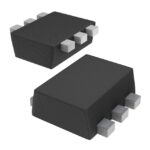 PEMH18,115
The activity of extra discounts on wholesale prices is in full swing…
Please fill in your contact information and we will send you the latest wholesale price list.




