 ChipApex | Global Electronic Components Supplier
SEARCH
Search Product
Search Post
— IC芯片 | 连接器 | 传感器 | 被动器件 —
Search productSearch post
— IC芯片 | 连接器 | 传感器 | 被动器件 —
Consult the customer manager about the wholesale price.
consultation hotline:86-132-6715-2157
email:[email protected]
Contact the product manager for consultation. One-stop consultation is available.
Do you want a lower wholesale price? Please send us your inquiry and we will reply immediately.
The PEMH9,115 is a dual NPN resistor-equipped transistor (RET) manufactured by Nexperia USA Inc. in an SOT-666 surface-mount package. It integrates two independent NPN transistors with built-in bias resistors: R1 (input) has a typical value of 10 kΩ, and the R2/R1 ratio is typically 4.7. The device supports a maximum collector-emitter voltage (VCEO) of 50 V and a continuous output current (IO) of 100 mA per transistor. Total power dissipation is rated at 300 mW at 25 °C ambient temperature. The transition frequency (fT) reaches 230 MHz, and the DC current gain (hFE) is guaranteed to be at least 100 at IC = 5 mA.
Verify the specific ordering suffix against the manufacturer's current catalog to confirm packaging details such as reel or cut tape specifications. Confirm that the non-automotive qualification status aligns with the target application environment, as this part lacks AEC-Q101 certification. Ensure the selected distributor provides traceable documentation matching the official Nexperia product data sheet revision.
Select this component when designing low-power digital interfaces requiring pre-biased NPN switches. The integrated 10 kΩ input resistor simplifies base drive networks compared to discrete transistors. Verify that the 50 V collector-emitter rating exceeds the maximum operating voltage of the controlled load. Consider the 300 mW total power dissipation limit when calculating thermal performance on the PCB footprint.
The PEMH9 belongs to the Nexperia RET family, which combines bipolar junction transistors with internal biasing networks. It serves as the NPN/NPN variant within a series that includes PNP/PNP (PEMB9) and complementary NPN/PNP (PEMD9) options. This family is designed to replace multiple discrete components in signal processing and switching tasks.
Direct functional equivalents include the PIMH9 and PUMH9, which share identical electrical characteristics but utilize different package types (SOT-457 and SOT-363 respectively). When substituting, verify pinout compatibility and physical dimensions to ensure the replacement fits the existing PCB layout constraints.
The input bias resistor (R1) has a typical value of 10 kΩ, and the ratio between the second resistor and R1 (R2/R1) is typically 4.7.
No, the PEMH9 is not automotive qualified. It has not been tested according to automotive standards and should not be used in life-critical or safety-critical systems.
The total power dissipation (Ptot) for the device is 300 mW when the ambient temperature is 25 °C or lower.
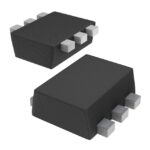 PEMH9,115
The activity of extra discounts on wholesale prices is in full swing…
Please fill in your contact information and we will send you the latest wholesale price list.




