ChipApex | Global Electronic Components Supplier
SEARCH
Search Product
Search Post
— IC芯片 | 连接器 | 传感器 | 被动器件 —
Search productSearch post
— IC芯片 | 连接器 | 传感器 | 被动器件 —
Consult the customer manager about the wholesale price.
consultation hotline:86-132-6715-2157
email:[email protected]
Contact the product manager for consultation. One-stop consultation is available.
Do you want a lower wholesale price? Please send us your inquiry and we will reply immediately.
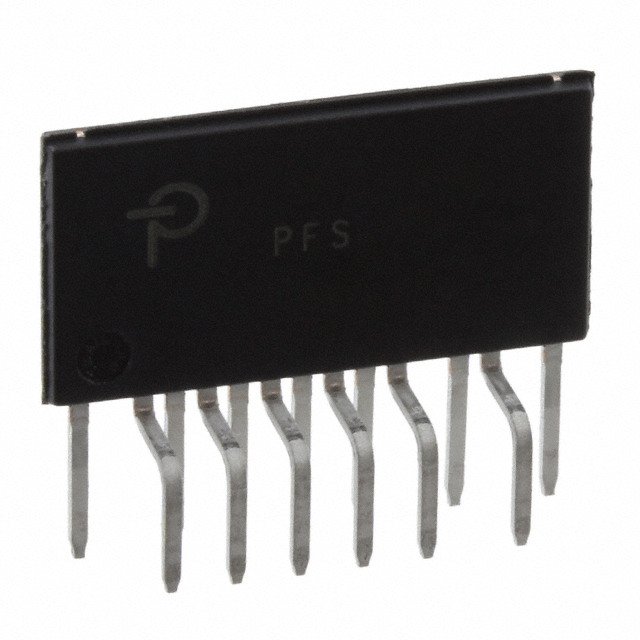
The PFS7724L is a HiperPFS-4 family power factor correction controller featuring an integrated 600 V power MOSFET and gate driver in an eSIP-16G package. It operates in continuous conduction mode (CCM) with a switching frequency range of 22 kHz to 123 kHz. The device supports a supply voltage of 10.2 V to 15 V and functions within a junction temperature range of -40°C to 150°C. Designed for through-hole mounting, it eliminates external current sense resistors to reduce power loss.
Verify component authenticity against Power Integrations official documentation before integration. Confirm that the eSIP-16G package orientation matches the PCB footprint design. Ensure thermal management strategies account for the 150°C maximum junction temperature rating during high-load operations. Cross-reference the specific ordering suffix with the manufacturer's latest datasheet to confirm pinout and electrical characteristics match the design requirements.
Select this component when designing systems requiring integrated PFC and power stage functionality without external current sensing resistors. It is suitable for applications needing dynamic frequency adjustment to optimize efficiency at light loads and reduce EMI filter size. Consider the eSIP-16G package constraints for thermal dissipation and board space. Verify compatibility with the required input line voltage ranges and output power levels defined in the HiperPFS-4 family specifications.
The PFS7724L belongs to the HiperPFS-4 series from Power Integrations, which combines digital control features with analog core techniques. This family targets high-performance power factor correction by integrating the controller, driver, and power switch. The design focuses on maximizing efficiency across varying load conditions while maintaining low standby power consumption through advanced line monitoring and feed-forward scaling capabilities.
The PFS5175F-TL is documented as a similar substitute part number from Power Integrations. Verify functional equivalence and pin compatibility before substitution. Review the specific datasheets for both components to ensure electrical parameters and package dimensions align with the existing design constraints.
 PFS7724L
The activity of extra discounts on wholesale prices is in full swing…
Please fill in your contact information and we will send you the latest wholesale price list.