ChipApex | Global Electronic Components Supplier
SEARCH
Search Product
Search Post
— IC芯片 | 连接器 | 传感器 | 被动器件 —
Search productSearch post
— IC芯片 | 连接器 | 传感器 | 被动器件 —
Consult the customer manager about the wholesale price.
consultation hotline:86-132-6715-2157
email:[email protected]
Contact the product manager for consultation. One-stop consultation is available.
Do you want a lower wholesale price? Please send us your inquiry and we will reply immediately.
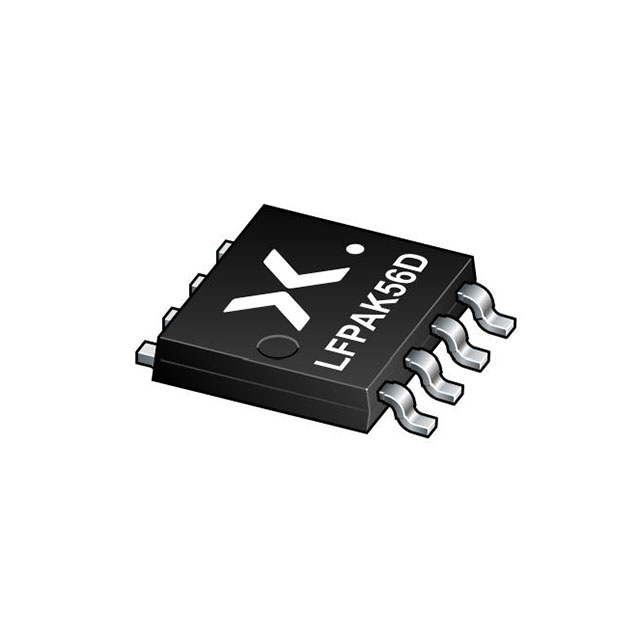
The Nexperia PHPT610030PK is a PNP/PNP high power double bipolar transistor housed in an SOT1205 (LFPAK56D) surface-mounted package. It features two independent PNP transistors within a single device, offering a collector-emitter voltage (VCEO) of -100 V and a continuous collector current (IC) of -3 A per transistor. The component supports junction temperatures up to 175 °C and provides a typical DC current gain (hFE) ranging from 10 to 40 at -3 A. Its thermal resistance from junction to ambient is typically 150 K/W in free air, with a total power dissipation capability of 25 W under specific mounting conditions.
Verify the exact ordering suffix against the manufacturer's official documentation before purchase. Confirm that the non-automotive qualification status aligns with your project requirements, as automotive-grade alternatives may be necessary for regulated industries. Ensure compatibility with the specified LFPAK56D footprint during the procurement phase.
Select this component when dual PNP configurations are required in a compact form factor. Evaluate the thermal resistance characteristics against your PCB copper area constraints to ensure adequate heat dissipation. Consider the -100 V rating and -3 A current capacity to verify suitability for your specific load switching or regulation tasks.
This device belongs to Nexperia's high power double bipolar transistor series, designed to replace discrete solutions in space-constrained designs. It serves as the PNP variant complement to the NPN/NPN PHPT610030NK and the complementary NPN/PNP PHPT610030NPK, providing design flexibility for push-pull or bridge topologies.
PHPT610030NK (NPN/NPN complement)
No, the product data sheet explicitly states that this specific device is not automotive qualified. Customers requiring automotive reliability should consult Nexperia for alternative products designated with the '-Q' suffix.
The maximum operating junction temperature (Tj) is rated at 175 °C, allowing for operation in high-temperature environments.
The LFPAK56D package reduces printed-circuit board requirements compared to transistors in DPAK packages while maintaining high thermal power dissipation capabilities.
 PHPT610030PKX
The activity of extra discounts on wholesale prices is in full swing…
Please fill in your contact information and we will send you the latest wholesale price list.