 ChipApex | Global Electronic Components Supplier
SEARCH
Search Product
Search Post
— IC芯片 | 连接器 | 传感器 | 被动器件 —
Search productSearch post
— IC芯片 | 连接器 | 传感器 | 被动器件 —
Consult the customer manager about the wholesale price.
consultation hotline:86-132-6715-2157
email:[email protected]
Contact the product manager for consultation. One-stop consultation is available.
Do you want a lower wholesale price? Please send us your inquiry and we will reply immediately.
The PI3USB4000AZUAEX is a differential bi-directional 2:1 multiplexer/demultiplexer switch manufactured by Diodes Incorporated. It supports USB 2.0 signals with a bandwidth of 1 GHz and operates on a supply voltage range of 2.7V to 6.0V. The device features an ultra-low ON capacitance of 7 pF and a typical ON resistance of 5 Ω. It includes over-voltage protection that triggers at 4.75 V, ensuring channel disconnection during high-voltage events. Common port pins tolerate up to 18 V, while channel pins tolerate up to 6 V. The component is housed in a 10-UQFN (1.5x2 mm) package.
Verify the ordering suffix 'ZUAEX' corresponds to the 10-pin UQFN package with tape and reel packaging. Confirm RoHS compliance and lead-free status against current manufacturer declarations. Ensure the procurement channel is authorized to avoid counterfeit components. Validate the specific revision level DS40145 Rev 4-2 if strict version control is required for the design.
Select this component when designing circuits requiring high voltage tolerance on data lines, such as MHL switching or fast charging scenarios. The 1.8 V logic compatibility allows direct interfacing with low-voltage microcontrollers. Consider the 10-UQFN package dimensions for PCB layout constraints. Verify that the 1 GHz bandwidth meets the signal requirements for the intended USB application.
This part belongs to the PI3USB4000A product line from Diodes Incorporated. It is functionally equivalent to other variants within the series, distinguished primarily by package type and ordering suffixes. The ZUA variant specifically denotes the 1.5x2 mm UQFN footprint. Other family members may utilize different packages like ZM or offer slight variations in electrical characteristics.
Direct substitutes include PI3USB4000AZMEX, which shares identical electrical specifications but utilizes a 1.4x1.8 mm UQFN package. Designers must verify pinout compatibility and thermal pad connections when swapping between ZUA and ZM package codes.
The C0+ and C0- pins can tolerate voltages up to 18 V.
Over-voltage protection activates at 4.75 V, immediately switching off the channels to protect downstream components.
The typical propagation delay is 0.25 ns.
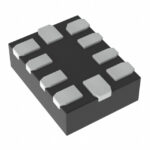 PI3USB4000AZUAEX
The activity of extra discounts on wholesale prices is in full swing…
Please fill in your contact information and we will send you the latest wholesale price list.





