 ChipApex | Global Electronic Components Supplier
SEARCH
Search Product
Search Post
— IC芯片 | 连接器 | 传感器 | 被动器件 —
Search productSearch post
— IC芯片 | 连接器 | 传感器 | 被动器件 —
Consult the customer manager about the wholesale price.
consultation hotline:86-132-6715-2157
email:[email protected]
Contact the product manager for consultation. One-stop consultation is available.
Do you want a lower wholesale price? Please send us your inquiry and we will reply immediately.
The PI6C557-03ALEX is a PCIe 2.0 compliant spread spectrum clock generator manufactured by Diodes Incorporated. It features two differential HCSL outputs and supports LVDS compatible signaling. The device accepts a 25 MHz crystal or clock input and generates output frequencies of 25, 100, 125, or 200 MHz via external pin selection. It operates on a 3.3V ±10% supply voltage with an operating temperature range of -40°C to +85°C. Key electrical parameters include a typical cycle-to-cycle jitter of 35 ps and a typical RMS jitter of 3.1 ps at 100 MHz. The component is housed in a 16-pin TSSOP package.
Verify the 'ALE' suffix indicates the 16-pin TSSOP package with Tape/Reel packaging. Confirm RoHS compliance and Halogen-free status as specified in the datasheet notes. Ensure the application circuit includes appropriate decoupling capacitors (0.01μF) near VDD pins and correct termination resistors for HCSL or LVDS signaling requirements.
Select this component when designing for PCIe 2.0 interfaces requiring low jitter and spread spectrum functionality. Ensure the design accommodates the 25 MHz input frequency requirement. Verify that the system power supply remains within the 3.0V to 3.6V range. Consider the thermal resistance characteristics if high ambient temperatures are expected.
This part belongs to the PI6C557 series of clock generators from Diodes Incorporated. The 'A' variant denotes specific electrical characteristics compliant with PCIe 2.0 standards. The 'LE' suffix specifies lead-free and green packaging, while 'X' indicates tape and reel delivery format.
For PCIe Gen 3 applications, consider the 5V41235. For PCIe Gen 2 applications requiring 5V operation, see the 5V41065. Direct pin-compatible replacements within the same family may exist but require verification of electrical specifications against the original design requirements.
The output frequency (25, 100, 125, or 200 MHz) is selected using the S0 and S1 input pins according to the configuration table provided in the datasheet.
Diodes recommends using a 25 MHz fundamental mode parallel resonant crystal with less than 300 PPM error across temperature, such as GC2500003 or FY2500081.
Yes, the SS0 and SS1 pins allow selection for no spread, down -0.5%, or down -0.75% spread spectrum modulation.
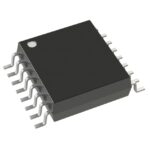 PI6C557-03ALEX
The activity of extra discounts on wholesale prices is in full swing…
Please fill in your contact information and we will send you the latest wholesale price list.





