 ChipApex | Global Electronic Components Supplier
SEARCH
Search Product
Search Post
— IC芯片 | 连接器 | 传感器 | 被动器件 —
Search productSearch post
— IC芯片 | 连接器 | 传感器 | 被动器件 —
Consult the customer manager about the wholesale price.
consultation hotline:86-132-6715-2157
email:[email protected]
Contact the product manager for consultation. One-stop consultation is available.
Do you want a lower wholesale price? Please send us your inquiry and we will reply immediately.
The PI6PCIEB24ZDEX is a 1:4 PCI Express 2.0 compliant high-speed differential clock driver manufactured by Diodes Incorporated. It distributes an input differential PCIe clock to four differential pairs of outputs using a zero-delay PLL. The device operates at 3.3V with a maximum frequency of 100 MHz in PLL mode. Key electrical parameters include propagation delay within ±250ps, output-to-output skew under 50ps, cycle-to-cycle jitter below 50ps, and additive RMS phase jitter less than 1ps. It utilizes a 20-pin TQFN package (ZD20) measuring 4.0mm x 4.0mm.
Verify the ZDEX suffix indicates Tape/Reel packaging as per datasheet ordering information. Confirm RoHS compliance and Green status for environmental requirements. Ensure the application supports the 3.3V supply voltage range of 3.135V to 3.465V. Check thermal management needs for the TQFN package.
Select this component when a single-ended or differential source must drive four independent PCIe 2.0 loads with minimal skew. The internal PLL allows operation up to 100 MHz. Designers must provide an external resistor on the IREF pin to set the output current accurately. Bypass mode is available via the PLL/BYPASS# pin for testing.
This part belongs to the Pericom PI6PCIEB24 family of PCIe clock drivers. The 'ZD' suffix denotes the 20-pin TQFN package, while 'E' signifies Pb-free and Green manufacturing. The 'X' suffix specifically indicates the unit is supplied in a tape and reel format for automated assembly.
Direct replacement requires matching the 1:4 differential output topology and TQFN-20 package. Verify that alternative devices support the same 3.3V operation and PCIe 2.0 jitter specifications.
The differential output current is set by connecting an external resistor to the IREF pin. The nominal test load configuration typically uses a 475Ω resistor.
When driven HIGH, the internal PLL is enabled for normal operation. When driven LOW, the PLL is bypassed, allowing direct signal transmission with a delay of 2.5ns to 6.5ns.
The device supports a maximum frequency of 100 MHz when operating in PLL mode.
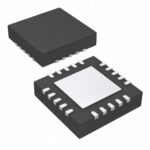 PI6PCIEB24ZDEX
The activity of extra discounts on wholesale prices is in full swing…
Please fill in your contact information and we will send you the latest wholesale price list.





