 ChipApex | Global Electronic Components Supplier

SEARCH
Search Product
Search Post
Search productSearch post
Consult the customer manager about the wholesale price.
consultation hotline:86-132-6715-2157
email:[email protected]
Contact the product manager for consultation. One-stop consultation is available.
Do you want a lower wholesale price? Please send us your inquiry and we will reply immediately.
PL607041UMG is listed in the Clock Generators, PLLs, Frequency Synthesizers range at ChipApex. The manufacturer field lists Microchip Technology. Its product description is IC CLK SYNTHESIZER DUAL 44QFN. Review the specifications below when checking this part for your BOM.
The PL607041UMG is a ClockWorks PCIe Quad Outputs ultra-low jitter HCSL frequency synthesizer manufactured by Micrel. It operates from a 2.5V or 3.3V power supply and synthesizes four HCSL clock outputs at 25MHz, 100MHz, 125MHz, and 200MHz using a 25MHz fundamental crystal input. The device features spread spectrum modulation for EMI reduction, achieving approximately 21dB to 24dB reduction. Typical phase jitter at 100MHz (1.5MHz to 10MHz) is 320fs. It complies with PCI Express Gen1, Gen2, and Gen3 standards and operates within an industrial temperature range of –40°C to +85°C in a 24-pin 4mm × 4mm QFN package.
Verify the manufacturer origin as Micrel Inc., not Microchip Technology, despite potential listing discrepancies. Confirm the specific ordering suffix (UMG for tube, UMG TR for tape and reel) matches the required shipping format. Ensure the component meets RoHS and PFOS compliance requirements specified in the datasheet.
Select based on the required output frequency configuration via S0/S1 pins and spread spectrum settings via SS0/SS1 pins. The device requires a 25MHz parallel resonant crystal with a 15pF load capacitance; no external load capacitors are needed. Ensure the power supply voltage aligns with the 2.5V or 3.3V operating range and that the PCB layout accommodates the 24-pin QFN package thermal requirements.
The PL607041 is part of the ClockWorks family of devices from Micrel, Inc. It is designed specifically to provide extremely low-noise spread-spectrum clocks for PCI Express requirements. The device integrates ripple blocking capabilities and supports industrial temperature ranges, making it suitable for high-performance computing and networking infrastructure applications.
The datasheet does not list direct substitute part numbers. Consider checking for other members of the Micrel ClockWorks family or newer revisions if availability is constrained, ensuring compatibility with HCSL outputs and PCI Express compliance.
No, the internal load capacitance is built into the die, so no external capacitance is needed for the 25MHz crystal input.
The typical RMS phase jitter is 320fs when measured at 100MHz with an integration range of 1.5MHz to 10MHz.
Spread spectrum is controlled by SS0 and SS1 pins. SS0 enables/disables the modulation, while SS1 selects the magnitude (-0.25% or -0.5%). Both pins have internal pull-up resistors.
Explore related parts through Clock/Timing, Integrated Circuits (ICs), all product categories, ChipApex homepage.
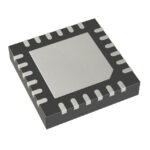 PL607041UMG

The activity of extra discounts on wholesale prices is in full swing…
Please fill in your contact information and we will send you the latest wholesale price list.






