ChipApex | Global Electronic Components Supplier
SEARCH
Search Product
Search Post
— IC芯片 | 连接器 | 传感器 | 被动器件 —
Search productSearch post
— IC芯片 | 连接器 | 传感器 | 被动器件 —
Consult the customer manager about the wholesale price.
consultation hotline:86-132-6715-2157
email:[email protected]
Contact the product manager for consultation. One-stop consultation is available.
Do you want a lower wholesale price? Please send us your inquiry and we will reply immediately.
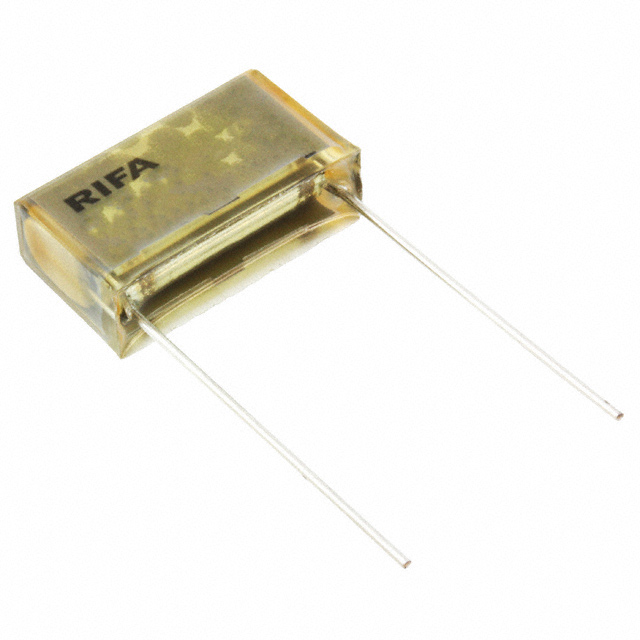
The KEMET PMR209MC6100M022R30 is a first-order low-pass RC EMI filter designed for through-hole mounting. It features a capacitance of 100 nF and a resistance of 22 Ohms with ±30% tolerance. Rated for 250 VAC and 630 VDC, it utilizes metallized paper dielectric. The component measures 24.00 mm in length, 11.30 mm in width, and 16.50 mm in height, operating within a temperature range of -40°C to 85°C.
Verify the specific suffix codes against official KEMET documentation to ensure correct capacitance, resistance, and voltage ratings. Confirm that the metallized paper construction aligns with your thermal and environmental requirements. Check for required certifications such as UL, VDE, or ENEC based on regional compliance standards before finalizing procurement.
Select this component when a combined RC network is preferred over discrete components to save board space. Ensure the 22 Ohm resistance value does not cause excessive voltage drop in your application. Verify that the 100 nF capacitance provides sufficient attenuation for your target frequency range while meeting safety isolation requirements.
This part belongs to the KEMET PMR209 series, which consists of RC EMI filters designed for general-purpose noise suppression. The series offers various combinations of resistance and capacitance values packaged in radial leads. These units are engineered for reliability in both AC and DC environments, providing a robust solution for electromagnetic interference mitigation.
Direct substitutes must match the 100 nF capacitance, 22 Ohm resistance, and 250 VAC rating. Verify that alternative parts maintain the same radial package dimensions and metallized paper dielectric type to ensure compatibility with existing footprints and safety certifications.
The PMR209MC6100M022R30 uses metallized paper dielectric, which is suitable for X2 safety class applications.
The component operates within a temperature range of -40°C to 85°C, making it suitable for standard industrial and commercial applications but not extreme high-temperature scenarios.
 PMR209MC6100M022R30
The activity of extra discounts on wholesale prices is in full swing…
Please fill in your contact information and we will send you the latest wholesale price list.