ChipApex | Global Electronic Components Supplier
SEARCH
Search Product
Search Post
— IC芯片 | 连接器 | 传感器 | 被动器件 —
Search productSearch post
— IC芯片 | 连接器 | 传感器 | 被动器件 —
Consult the customer manager about the wholesale price.
consultation hotline:86-132-6715-2157
email:[email protected]
Contact the product manager for consultation. One-stop consultation is available.
Do you want a lower wholesale price? Please send us your inquiry and we will reply immediately.
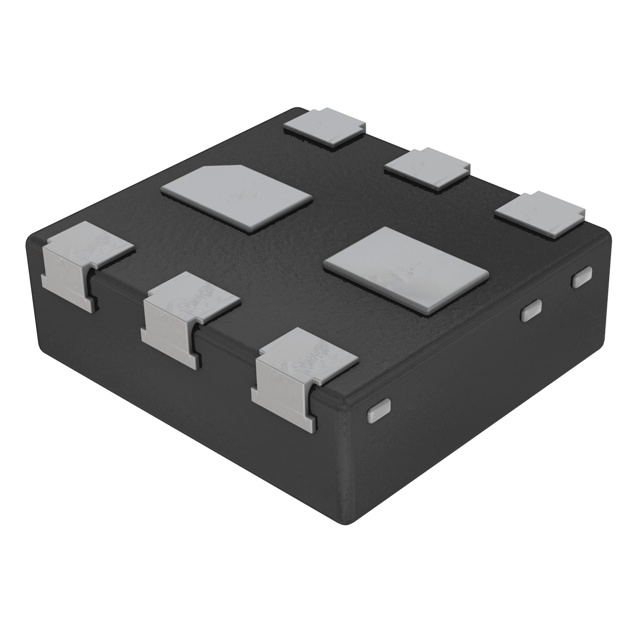
The PQMD2Z is a dual NPN/PNP resistor-equipped transistor (RET) in a SOT363 plastic surface-mount package. It integrates two transistors with built-in bias resistors, R1 and R2, each valued at 100 kΩ. The device provides a combined output current capability of 100 mA. It operates within an ambient temperature range of -55 °C to +150 °C. The component features ESD protection rated at HBM Class 2 (2000 V) and CDM Class C3 (1000 V). Electrical characteristics include a DC current gain (hFE) ranging from 100 to 200 for the NPN section and 100 to 200 for the PNP section under specified conditions.
Verify the specific ordering code suffix against the official Nexperia datasheet to confirm the exact resistor values and package variant. Ensure the procurement channel is an authorized distributor to guarantee authenticity and traceability. Check the Longevity Program status for expected availability duration before finalizing supply chain agreements.
Select this component when circuit design requires both NPN and PNP switching functions with minimal external passive components. The 100 kΩ internal resistors simplify biasing networks compared to discrete alternatives. Verify that the 100 mA total current rating meets the load requirements for both channels simultaneously during peak operation.
This part belongs to Nexperia's family of Resistor-Equipped Transistors (RETs), designed to reduce bill-of-materials count and assembly costs. It utilizes the compact SOT363 package, which is suitable for high-density PCB layouts common in modern consumer electronics and portable devices requiring efficient space utilization.
Direct substitutes must match the SOT363 package, dual RET topology, and 100 kΩ resistor values. Verify pinout compatibility and electrical parameters such as hFE ranges and maximum voltage ratings. Cross-reference with other manufacturers' dual RET offerings ensuring identical functional specifications.
Both the NPN and PNP sections feature built-in bias resistors with a value of 100 kΩ.
Yes, the component is AEC-Q101 qualified, making it suitable for automotive environments.
The device is specified for an ambient temperature range up to 150 °C, indicating robust thermal performance.
 PQMD2Z
The activity of extra discounts on wholesale prices is in full swing…
Please fill in your contact information and we will send you the latest wholesale price list.