 ChipApex | Global Electronic Components Supplier
SEARCH
Search Product
Search Post
— IC芯片 | 连接器 | 传感器 | 被动器件 —
Search productSearch post
— IC芯片 | 连接器 | 传感器 | 被动器件 —
Consult the customer manager about the wholesale price.
consultation hotline:86-132-6715-2157
email:[email protected]
Contact the product manager for consultation. One-stop consultation is available.
Do you want a lower wholesale price? Please send us your inquiry and we will reply immediately.
The PRMH10 is a dual NPN Resistor-Equipped Transistor (RET) from Nexperia, housed in an ultra-small DFN1412-6 (SOT1268) leadless surface-mount package. It integrates two NPN transistors with built-in bias resistors to simplify circuit design and reduce component count. The device supports a collector-emitter voltage of 50 V and an output current of 100 mA per transistor. Key electrical parameters include a DC current gain (hFE) of at least 100 at IC = 10 mA, a transition frequency (fT) of 230 MHz, and a total power dissipation of 480 mW for the device. The package height is 0.5 mm, and it is qualified under AEC-Q101 standards.
Verify the specific ordering suffix against the manufacturer's official catalog to ensure correct packaging and tape-and-reel specifications. Confirm that the DFN1412-6 footprint matches your PCB layout guidelines. Check the latest product data sheet for any updates to marking codes or thermal derating curves before finalizing procurement orders.
Select the PRMH10 when a dual NPN configuration with fixed biasing is required in a minimal footprint. Ensure the application voltage does not exceed the 50 V collector-emitter rating. Consider the 480 mW total power dissipation limit and verify thermal management on the FR4 PCB if operating near maximum ratings. The AEC-Q101 qualification makes it suitable for automotive-grade designs.
The PRMH10 belongs to Nexperia's RET family of resistor-equipped double transistors. It serves as the NPN/NPN complement to the PRMD10 (NPN/PNP). Both devices share the same DFN1412-6 package and are designed to replace multiple discrete components in digital switching and logic interface applications, offering reduced assembly costs and board space.
The PRMD10 is the complementary NPN/PNP variant within the same package. For single-transistor replacements, discrete BC847 types may be used but will require additional external bias resistors and occupy more board area. No direct pin-compatible substitutes with identical internal resistor values are listed in the public datasheet.
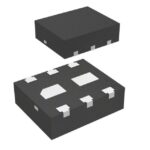 PRMH10Z
The activity of extra discounts on wholesale prices is in full swing…
Please fill in your contact information and we will send you the latest wholesale price list.




