 ChipApex | Global Electronic Components Supplier
SEARCH
Search Product
Search Post
— IC芯片 | 连接器 | 传感器 | 被动器件 —
Search productSearch post
— IC芯片 | 连接器 | 传感器 | 被动器件 —
Consult the customer manager about the wholesale price.
consultation hotline:86-132-6715-2157
email:[email protected]
Contact the product manager for consultation. One-stop consultation is available.
Do you want a lower wholesale price? Please send us your inquiry and we will reply immediately.
The PS8802-1-F3-A is a high-speed, single-channel optically coupled isolator manufactured by CEL. It integrates a GaAlAs LED on the input side with a PIN photodiode and high-speed amplifier transistor on the output side within a single chip. Designed for applications requiring high common-mode transient immunity (CMR), this component operates at data speeds up to 1 Mbps. The device features an analog output type and is housed in an 8-pin SSOP package. Key electrical specifications include a minimum common-mode transient immunity of 15 kV/µs, an isolation voltage of 2500 Vrms, and a propagation delay of 0.8 ns (tPHL) and 1.2 ns (tPLH).
Verify the specific suffix (e.g., -F3-A) against the manufacturer's current datasheet to ensure correct packaging and tape-and-reel specifications. Confirm that the required safety certifications (UL, VDE, CSA) are explicitly listed for the ordered variant. Ensure the operating temperature range meets system requirements before finalizing procurement.
Select this component when a single channel with analog output and high CMR is required. Compare propagation delays and CTR values against system timing constraints. Ensure the 8-pin SSOP package fits the PCB layout. Verify that the 1 Mbps speed is sufficient for the application, as higher-speed digital options may be available in other series.
The PS8802 series belongs to CEL's family of high-speed photocouplers. The PS8802-1 variant specifically denotes a single-channel configuration, distinguishing it from dual-channel models like the PS8802-2. This series is engineered to provide robust isolation in electrically noisy industrial environments while maintaining signal integrity through high-speed amplification.
Check for direct pin-compatible replacements within the PS8802 series, such as the PS8802-1-V-F3 or PS8802-1-F3, ensuring identical electrical characteristics and package dimensions. Verify that any substitute maintains the same safety approvals and CMR ratings.
The maximum propagation delay is 0.8 ns for low-to-high transition (tPHL) and 1.2 ns for high-to-low transition (tPLH).
It features an analog output type, utilizing a PIN photodiode and high-speed amplifier transistor.
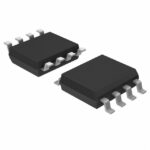 PS8802-1-F3-A
The activity of extra discounts on wholesale prices is in full swing…
Please fill in your contact information and we will send you the latest wholesale price list.





