 ChipApex | Global Electronic Components Supplier

SEARCH
Search Product
Search Post
— IC芯片 | 连接器 | 传感器 | 被动器件 —
Search productSearch post
— IC芯片 | 连接器 | 传感器 | 被动器件 —
Consult the customer manager about the wholesale price.
consultation hotline:86-132-6715-2157
email:[email protected]
Contact the product manager for consultation. One-stop consultation is available.
Do you want a lower wholesale price? Please send us your inquiry and we will reply immediately.
PT8A263PE is listed in the Sensor And Detector Interfaces range at ChipApex. The manufacturer field lists Diodes Incorporated. Its product description is PIR CONTROLLER DIP-16. Review the specifications below when checking this part for your BOM.
The PT8A263PE is a mixed-signal CMOS LSI chip designed for PIR alarm control systems. It operates at a supply voltage of 4.75V to 6.0V with a typical quiescent current of 70µA and system oscillator frequency of 16kHz. The device features an internal low battery detector threshold of approximately 3.8V, a 3.6V regulator output on the VEE pin, and two operational amplifiers for signal filtering. It provides four selectable operation modes via SEL1 and SEL2 pins, driving outputs OUT1 and OUT2 to trigger external devices such as buzzers or doorbell ICs.
Verify component authenticity through authorized Diodes Incorporated channels. Confirm package type matches DIP-16 or SOIC-16 requirements. Ensure ordering suffixes align with specific tape/reel or tube packaging needs. Validate that the selected variant meets environmental specifications for intended deployment conditions.
Select based on required operational mode configuration using SEL1 and SEL2 pins. Consider package preference between lead-free DIP-16 and SOIC-16 formats. Verify compatibility with external PIR sensor interfaces connected to OP1P and OP1N inputs. Ensure power supply constraints align with the specified 4.75V to 6.0V operating range.
This component belongs to the PT8A26x series of PIR alarm controllers manufactured by Pericom Semiconductor Corporation, now part of Diodes Incorporated. It shares architectural similarities with the PT8A261 but includes additional integrated features like the low battery detector and multiple output drive capabilities for versatile alarm system implementations.
PT8A261 serves as a foundational predecessor in the same product family. Direct substitution requires verification of functional differences regarding low battery detection and multi-mode output configurations.
The internal low battery detector triggers when VCC drops below approximately 3.8V, halting most internal circuits while maintaining oscillator and LED indication functions.
The system frequency is generated by connecting an external resistor and capacitor to the OSC pin, typically set to 16kHz for standard applications.
Modes are configured by setting logic levels on the SEL1 and SEL2 pins, enabling Normal Alarm, Normal Alarm with Delay, Siren Alarm, or Door Chime functionality.
Explore related parts through Interface, Integrated Circuits (ICs), all product categories, ChipApex homepage.
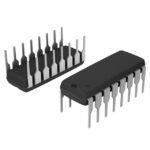 PT8A263PE

The activity of extra discounts on wholesale prices is in full swing…
Please fill in your contact information and we will send you the latest wholesale price list.





