 ChipApex | Global Electronic Components Supplier
SEARCH
Search Product
Search Post
— IC芯片 | 连接器 | 传感器 | 被动器件 —
Search productSearch post
— IC芯片 | 连接器 | 传感器 | 被动器件 —
Consult the customer manager about the wholesale price.
consultation hotline:86-132-6715-2157
email:[email protected]
Contact the product manager for consultation. One-stop consultation is available.
Do you want a lower wholesale price? Please send us your inquiry and we will reply immediately.
The PUMD4,115 is a dual pre-biased NPN/PNP transistor array manufactured by Nexperia USA Inc. It integrates two transistors with built-in bias resistors in a compact surface-mount package. The device features a maximum collector-emitter voltage (Vceo) of 50V and a continuous collector current (Ic) of 100mA per transistor. The internal base resistor (R1) is specified at 10 kΩ, while the emitter resistor (R2) is left open. Key electrical parameters include a DC current gain (hFE) minimum of 30 at Ic=5mA, Vce=5V, and a saturation voltage (Vce(sat)) maximum of 150mV at Ib=500µA, Ic=10mA. The component supports an operating temperature range from -65°C to +150°C and is housed in a 6-TSSOP (SC-88/SOT-363) package.
Verify the specific ordering suffix and packaging format required for production integration. Confirm that the 6-TSSOP footprint matches the PCB layout constraints. Ensure compliance with RoHS3 directives and REACH regulations as stated in the official documentation. Check for any recent Product Change Notifications regarding assembly or labeling updates before finalizing procurement orders.
Select this component when space-constrained designs require dual switching functions with integrated biasing. The 50V rating and 100mA current capacity suit low-power digital logic interfacing. Consider the 10kΩ base resistance value for appropriate drive current requirements. Verify thermal management capabilities within the 300mW power dissipation limit for the intended application environment.
This part belongs to the PUMD series of resistor-equipped transistors from Nexperia. It serves as a compact alternative to discrete transistor networks, offering reduced pick-and-place costs. The device is designed for high-volume manufacturing in consumer electronics and automotive systems where board space is limited.
Publicly confirmed substitute part numbers are not available in the provided source material. Engineers should consult official Nexperia documentation for qualified alternatives or cross-reference compatible devices based on pinout and electrical specifications.
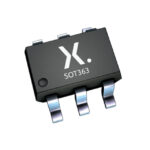 PUMD4,115
The activity of extra discounts on wholesale prices is in full swing…
Please fill in your contact information and we will send you the latest wholesale price list.




