 ChipApex | Global Electronic Components Supplier
SEARCH
Search Product
Search Post
— IC芯片 | 连接器 | 传感器 | 被动器件 —
Search productSearch post
— IC芯片 | 连接器 | 传感器 | 被动器件 —
Consult the customer manager about the wholesale price.
consultation hotline:86-132-6715-2157
email:[email protected]
Contact the product manager for consultation. One-stop consultation is available.
Do you want a lower wholesale price? Please send us your inquiry and we will reply immediately.
The Nexperia PUMH9,125 is a dual NPN resistor-equipped transistor (RET) housed in a SOT363-3 (SC-88) surface-mount package. It integrates two isolated transistors with built-in bias resistors: R1 = 10 kΩ and R2 = 47 kΩ. Key electrical parameters include a collector-emitter voltage (VCEO) of 50 V, an output current (IO) of 100 mA per transistor, and a total power dissipation of 300 mW at 25 °C ambient temperature. The device features a minimum DC current gain (hFE) of 100 at IC = 5 mA and VCE = 5 V, with a typical transition frequency (fT) of 230 MHz.
Verify the specific ordering suffix against the manufacturer's official documentation to confirm packaging details such as reel size or tape width. Confirm RoHS compliance status and moisture sensitivity level requirements prior to procurement. Ensure the selected variant matches the required marking code and manufacturing site specifications for your assembly process.
Select this component when space-constrained designs require dual NPN switching with integrated base drive resistors. The SOT363-3 package offers a compact footprint suitable for high-density PCB layouts. Consider the 10 kΩ input resistance and 47 kΩ pull-down ratio for appropriate logic interface matching. Verify thermal performance under expected load conditions given the 300 mW total power dissipation limit.
The PUMH9 belongs to Nexperia's Resistor-Equipped Transistor (RET) family, designed to replace multiple discrete components. It serves as the NPN/NPN complement to the PUMB9 (PNP/PNP) and PUMD9 (NPN/PNP) variants. This series is engineered to reduce bill-of-materials complexity and assembly time in portable and industrial electronics by consolidating biasing networks into a single small-outline package.
Direct functional equivalents within the same RET family include the PUMB9 and PUMD9 for complementary configurations. For general-purpose NPN replacements without integrated resistors, consider standard BJT arrays like the BC847 series, though these will require external biasing components.
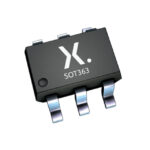 PUMH9,125
The activity of extra discounts on wholesale prices is in full swing…
Please fill in your contact information and we will send you the latest wholesale price list.




