 ChipApex | Global Electronic Components Supplier
SEARCH
Search Product
Search Post
— IC芯片 | 连接器 | 传感器 | 被动器件 —
Search productSearch post
— IC芯片 | 连接器 | 传感器 | 被动器件 —
Consult the customer manager about the wholesale price.
consultation hotline:86-132-6715-2157
email:[email protected]
Contact the product manager for consultation. One-stop consultation is available.
Do you want a lower wholesale price? Please send us your inquiry and we will reply immediately.
The PZD22B2V4C is a silicon Zener diode from the PZD22B series manufactured by Panjit International Inc. It features a nominal Zener voltage of 2.4 V with a tolerance range of 2.28 V to 2.52 V at a test current of 5 mA. The device operates within a power dissipation limit of 200 mW and utilizes an SOT-323 surface-mount package. Electrical characteristics include a maximum reverse leakage current of 50 µA at 1 V, a typical Zener impedance of 100 Ω at 5 mA, and a maximum impedance of 600 Ω at 5 mA. Thermal resistance from junction to ambient is typically 540 °C/W, supporting an operating temperature range of -55 °C to +150 °C.
Verify component authenticity by cross-referencing the manufacturer's datasheet revision date and part number against official Panjit documentation. Confirm that the received units match the specified SOT-323 package dimensions and marking code AFH. Ensure compliance with environmental standards such as RoHS 2.0 and IEC 61249 during the sourcing process.
Select this component when a precise 2.4 V reference or clamp is required in space-constrained designs utilizing the SOT-323 footprint. Consider the 200 mW power dissipation limit and thermal resistance when designing heat management strategies. Verify that the 50 µA maximum reverse leakage current meets the specific requirements of the target circuit application.
This component belongs to the PZD22B2V4C ~ PZD22B75C series, which offers a wide range of Zener voltages from 2.4 V to 75 V. All devices in this series share identical mechanical packaging, thermal characteristics, and manufacturing features, differing primarily in their electrical breakdown parameters and marking codes.
Direct substitutes must maintain the 2.4 V nominal voltage, SOT-323 package, and 200 mW power rating. Verify compatibility regarding Zener impedance and leakage current specifications before implementation.
The marking code for the PZD22B2V4C is AFH.
The datasheet provides a typical junction capacitance curve but does not list a single fixed value; it varies based on the applied reverse voltage.
No, the datasheet explicitly states that these products are not authorized for use in medical instruments, transportation equipment, aerospace machinery, or other life-saving applications.
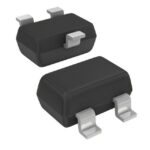 PZD22B2V4C-AU_R1_000A1
The activity of extra discounts on wholesale prices is in full swing…
Please fill in your contact information and we will send you the latest wholesale price list.




