 ChipApex | Global Electronic Components Supplier
SEARCH
Search Product
Search Post
— IC芯片 | 连接器 | 传感器 | 被动器件 —
Search productSearch post
— IC芯片 | 连接器 | 传感器 | 被动器件 —
Consult the customer manager about the wholesale price.
consultation hotline:86-132-6715-2157
email:[email protected]
Contact the product manager for consultation. One-stop consultation is available.
Do you want a lower wholesale price? Please send us your inquiry and we will reply immediately.
The QT100A-ISMG is a single-channel digital touch sensor IC utilizing patented spread-spectrum charge-transfer technology. It operates within a supply voltage range of 2.0V to 5.5V, consuming 6.5µA at 2.0V in low power mode. The device features an active-high digital output and supports Fast, Low Power, and Sync run modes. It includes internal self-calibration, drift compensation, and noise filtering. The component is housed in a 10-pin MSOP package with a Moisture Sensitivity Level (MSL) rating of 1.
Verify the specific ordering suffix ISMG corresponds to the 10-MSOP package variant with MSL1 rating as documented in the official datasheet. Confirm that the supplier provides the original manufacturer documentation to ensure the component matches the specified electrical characteristics and pinout configuration.
Select this component when a single-channel capacitive touch interface is required. Ensure the application panel thickness and dielectric constant are compatible with the recommended sample capacitor range of 2nF to 50nF. Verify that the system power supply remains stable between 2.0V and 5.5V to maintain proper operation.
The QT100A is designed to replace the earlier QT100 model while offering behavioral compatibility. The ISMG suffix specifically denotes the 10-pin MSOP package option, distinct from the 6-WSON variant. This family utilizes QTouch technology for human-machine interfaces requiring robust proximity and touch detection capabilities.
The QT100A serves as a direct replacement for the QT100. When converting designs, note that the 6-WSON package requires attention to the bottom center pad grounding to prevent shorts, whereas the 10-MSOP variant does not share this specific footprint constraint.
The device employs asymmetric drift compensation where the reference level tracks the raw signal slowly during non-detection states. It compensates faster for decreasing signals than increasing ones to prevent false triggers from approaching objects.
The SYNC pin determines the operating mode. Holding it high enables Fast mode, holding it low enables Low Power mode, and applying an external waveform synchronizes the device to an external clock source to prevent cross-interference.
The HeartBeat™ feature places the output pin into a three-state mode for 15µs before every measurement burst. This pulse can be sampled by a microcontroller or counter to verify that the sensor is operating correctly without affecting normal touch detection.
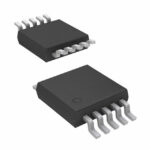 QT100A-ISMG
The activity of extra discounts on wholesale prices is in full swing…
Please fill in your contact information and we will send you the latest wholesale price list.





