 ChipApex | Global Electronic Components Supplier
SEARCH
Search Product
Search Post
— IC芯片 | 连接器 | 传感器 | 被动器件 —
Search productSearch post
— IC芯片 | 连接器 | 传感器 | 被动器件 —
Consult the customer manager about the wholesale price.
consultation hotline:86-132-6715-2157
email:[email protected]
Contact the product manager for consultation. One-stop consultation is available.
Do you want a lower wholesale price? Please send us your inquiry and we will reply immediately.
The QT161S-25.000MEEV-T is a quartz crystal resonator manufactured by QST, designed for precision frequency control in electronic circuits. This component operates at a fundamental frequency of 25.000 MHz and utilizes an AT-cut resonator design to ensure stable performance across varying temperature conditions. It is housed in a compact SMD package, specifically the 3215 (1210) metric size, facilitating automated surface-mount assembly processes. The device features a load capacitance specification compatible with standard oscillator configurations, ensuring accurate frequency generation when paired with appropriate external circuitry.
Verify the specific load capacitance requirements against your oscillator circuit design before procurement. Ensure that the soldering profile adheres to QST's recommended thermal guidelines to maintain frequency accuracy. Confirm that the packaging format matches your pick-and-place equipment specifications. Always request the latest datasheet from authorized distributors to confirm current manufacturing status and any potential obsolescence notices prior to finalizing purchase orders.
Select this component based on its 25 MHz operating frequency and 3215 package dimensions. Consider the required load capacitance and equivalent series resistance values for your specific oscillator topology. Evaluate the temperature stability requirements of your application to ensure the standard commercial grade meets operational needs. Verify compatibility with your PCB layout constraints regarding footprint size and spacing requirements.
This part belongs to QST's line of surface-mount quartz crystal resonators. It is engineered for use in devices requiring precise timing signals. The model designation indicates a 25 MHz frequency and a specific package variant. These components are widely used in digital systems where clock synchronization is critical for data integrity and system performance.
Direct substitutes must match the 25 MHz frequency, 3215 package, and electrical characteristics. Check manufacturer cross-reference lists for equivalent parts from other suppliers. Ensure pinout compatibility and mounting hole positions if mechanical retention is required. Validate that alternative components meet the same frequency tolerance and stability standards.
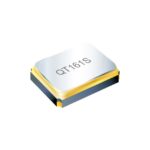 QT161S-25.000MEEV-T
The activity of extra discounts on wholesale prices is in full swing…
Please fill in your contact information and we will send you the latest wholesale price list.





