 ChipApex | Global Electronic Components Supplier
SEARCH
Search Product
Search Post
— IC芯片 | 连接器 | 传感器 | 被动器件 —
Search productSearch post
— IC芯片 | 连接器 | 传感器 | 被动器件 —
Consult the customer manager about the wholesale price.
consultation hotline:86-132-6715-2157
email:[email protected]
Contact the product manager for consultation. One-stop consultation is available.
Do you want a lower wholesale price? Please send us your inquiry and we will reply immediately.
The QT161S-32.000MAAV-T is a surface-mount quartz crystal resonator manufactured by QST, designed for precise frequency generation in electronic circuits. It operates at a fundamental frequency of 32 MHz with a load capacitance of 8 pF. The component exhibits a frequency tolerance and stability of ±30 ppm within an operating temperature range of -20°C to +70°C. Housed in a compact 4-SMD, No Lead package measuring 1.6 mm x 1.2 mm, it features an equivalent series resistance (ESR) of 80 Ohms. This device supports base harmonic operation and is suitable for applications requiring reliable timing signals in space-constrained designs.
Verify the specific suffix 'MAAV-T' against the manufacturer's current datasheet to ensure alignment with the required frequency tolerance and temperature range specifications. Confirm that the 4-SMD footprint dimensions match the target PCB layout constraints. Check for any recent updates to the RoHS3 compliance status or material declarations prior to finalizing procurement orders to ensure regulatory adherence.
Select this component when a 32 MHz reference signal is required with moderate stability requirements. The 8 pF load capacitance must match the oscillator circuit design parameters to ensure accurate frequency output. Consider the 80 Ohm ESR value for drive level sensitivity. Ensure the operating environment remains within the specified -20°C to +70°C range to maintain the guaranteed ±30 ppm stability.
This part belongs to the QT161S series of thin-film quartz crystals from QST. These components are engineered for high-frequency applications where small form factors are critical. The series offers various frequency options and tolerance grades, with this specific model providing a standard 32 MHz output optimized for general-purpose digital timing applications in consumer and industrial hardware.
Direct substitutes may include other 32 MHz SMD crystals with identical 4-SMD footprints and 8 pF load capacitance. Verify that alternative parts meet the same ±30 ppm stability and -20°C to +70°C temperature range requirements. Ensure the replacement component has comparable ESR characteristics to maintain circuit oscillation reliability.
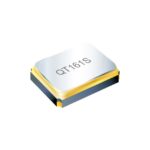 QT161S-32.000MAAV-T
The activity of extra discounts on wholesale prices is in full swing…
Please fill in your contact information and we will send you the latest wholesale price list.




