ChipApex | Global Electronic Components Supplier
SEARCH
Search Product
Search Post
— IC芯片 | 连接器 | 传感器 | 被动器件 —
Search productSearch post
— IC芯片 | 连接器 | 传感器 | 被动器件 —
Consult the customer manager about the wholesale price.
consultation hotline:86-132-6715-2157
email:[email protected]
Contact the product manager for consultation. One-stop consultation is available.
Do you want a lower wholesale price? Please send us your inquiry and we will reply immediately.
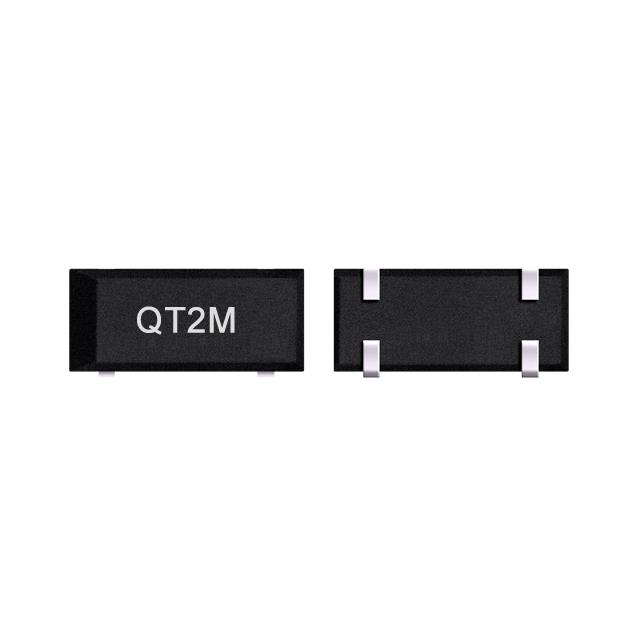
The QST QT2M-32.768KHZB-T is a surface-mount crystal oscillator designed for precise timing applications. It operates at a fundamental frequency of 32.768 kHz, a standard rate for real-time clock circuits. The device utilizes a thin-film bulk acoustic resonator (FBAR) or similar advanced technology to ensure stability and low phase noise. Key electrical parameters include a load capacitance typically specified by the manufacturer, frequency tolerance within ±20 ppm over temperature, and an operating voltage range suitable for portable electronics. The component is housed in a compact SMD package, facilitating automated assembly and space-constrained designs.
Verify the specific load capacitance and frequency tolerance requirements against your circuit design before ordering. Ensure the reflow soldering profile complies with the manufacturer's thermal recommendations to prevent damage. Confirm that the packaging type matches your pick-and-place equipment capabilities. Request a datasheet update if working with legacy projects to ensure compliance with current RoHS standards.
Choose this component when a stable 32.768 kHz reference is critical for timekeeping accuracy. Consider the operating temperature range to ensure reliability in extreme environments. Evaluate the size constraints of the PCB to confirm the footprint compatibility. Assess the power budget of the system to verify that the oscillator's current draw aligns with energy efficiency goals.
This part belongs to QST's line of precision timing solutions, focusing on miniaturized oscillators for modern electronics. The 32.768 kHz frequency is widely adopted due to its binary divisibility, making it ideal for digital counters. Competing products often offer similar frequencies but may vary in package size and initial accuracy. This model represents a balance between cost-effectiveness and performance for mass-produced devices.
Direct substitutes must match the 32.768 kHz frequency, package dimensions, and pin configuration. Verify equivalent load capacitance and drive level specifications to maintain circuit stability. Cross-reference with other manufacturers' FBAR or SAW oscillators offering similar tolerance grades. Ensure any replacement meets the same environmental and regulatory certifications.
 QT2M-32.768KHZB-T
The activity of extra discounts on wholesale prices is in full swing…
Please fill in your contact information and we will send you the latest wholesale price list.