 ChipApex | Global Electronic Components Supplier

SEARCH
Search Product
Search Post
— IC芯片 | 连接器 | 传感器 | 被动器件 —
Search productSearch post
— IC芯片 | 连接器 | 传感器 | 被动器件 —
Consult the customer manager about the wholesale price.
consultation hotline:86-132-6715-2157
email:[email protected]
Contact the product manager for consultation. One-stop consultation is available.
Do you want a lower wholesale price? Please send us your inquiry and we will reply immediately.
QT301-IS is listed in the ADCs/DACs - Special Purpose range at ChipApex. The manufacturer field lists Microchip Technology. Its product description is IC CAP TO ANLG CONVRTR 8SOIC. Review the specifications below when checking this part for your BOM.
The QT301-IS is a standalone Capacitance-to-Analog Converter (CAC) utilizing a patented charge-transfer method. It detects femtofarad-level capacitance changes and outputs an 8-bit resolution, 100 kHz PWM signal. The device operates on a single supply voltage ranging from 3 V to 5.5 V. Key features include spread-spectrum burst modulation for noise rejection, end-to-end calibration via CAL pins, and sample-on-demand functionality through a Sync input. It requires only one external sampling capacitor (Cs) between 1 nF and 500 nF.
Verify the -IS suffix indicates the industrial temperature range (-40°C to +85°C). Confirm the package type matches the required footprint, as the datasheet lists both DIP and SOIC options. Check current availability status as the component may be discontinued or subject to lifecycle changes.
Select based on the required capacitance range (Cx) and sensitivity. The sampling capacitor (Cs) value, adjustable from 1 nF to 500 nF, directly influences gain and response time. Ensure the power supply is stable, as VDD fluctuations affect the PWM output. Use NPO/PPS capacitors for Cs to maintain stability across temperatures.
The QT301 is manufactured by QRG Ltd (now QProx) and distributed by Microchip Technology. It is designed for stand-alone instrumentation applications where raw capacitance data is processed externally. Unlike integrated MCUs, it provides unprocessed PWM data suitable for simple RC filtering or timer measurement.
Publicly confirmed substitute part numbers are not available in the provided documentation. Evaluate other CAC ICs from the same manufacturer or competitors based on interface compatibility and capacitance detection range.
Calibration is triggered by asserting the CAL_DN or CAL_UP pins high for at least 2.5 ms. The device stores the endpoints in internal EEPROM and releases the pin when complete.
The Sync pin allows the device to synchronize acquisition bursts with external signals, such as mains frequency, to suppress interference. If no sync pulse is received for 100 ms, the device reverts to its default timing.
No. Driving either CAL pin low will short-circuit the chip. They must be pulled low via a pulldown resistor and driven high via an open-source output or transistor emitter.
Explore related parts through Data Acquisition, Integrated Circuits (ICs), all product categories, ChipApex homepage.
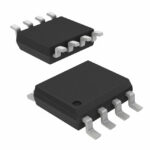 QT301-IS

The activity of extra discounts on wholesale prices is in full swing…
Please fill in your contact information and we will send you the latest wholesale price list.





