ChipApex | Global Electronic Components Supplier
SEARCH
Search Product
Search Post
— IC芯片 | 连接器 | 传感器 | 被动器件 —
Search productSearch post
— IC芯片 | 连接器 | 传感器 | 被动器件 —
Consult the customer manager about the wholesale price.
consultation hotline:86-132-6715-2157
email:[email protected]
Contact the product manager for consultation. One-stop consultation is available.
Do you want a lower wholesale price? Please send us your inquiry and we will reply immediately.
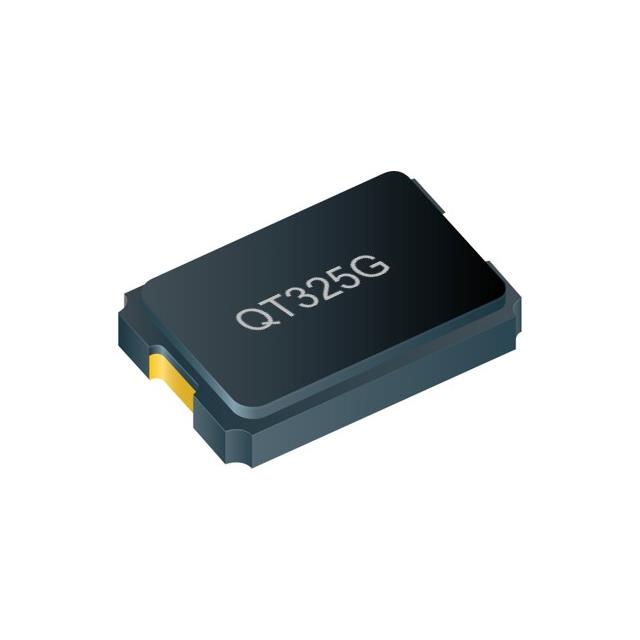
The QT325G-16.000MEEJ-T is a surface-mount quartz crystal resonator manufactured by QST, designed for precise frequency generation in electronic circuits. It operates at a fundamental frequency of 16.000 MHz with a frequency tolerance of ±10 ppm within the temperature range of -30°C to +85°C. The component features a load capacitance of 12 pF and an equivalent series resistance (ESR) of 60 Ohms maximum. It utilizes a compact 4-SMD, No Lead package with dimensions of 3.2 mm x 2.5 mm x 0.8 mm, suitable for automated assembly processes.
Verify the specific suffix J indicates the required ±10 ppm tolerance and -30°C to +85°C operating range against your schematic requirements. Confirm that the 12 pF load capacitance matches your oscillator circuit design. Ensure the 4-SMD footprint aligns with your PCB layout constraints. Request manufacturer datasheets to validate electrical characteristics prior to final procurement decisions.
Select this component when a 16 MHz reference signal is required with strict stability needs beyond standard commercial grades. The ±10 ppm tolerance makes it suitable for applications sensitive to frequency drift. Consider the 12 pF load capacitance compatibility with your MCU or oscillator IC inputs. The no-lead SMD format supports high-volume manufacturing workflows while maintaining small board space utilization.
This part belongs to QST's QT325G series of thin-film bulk acoustic resonator crystals. The series offers various frequency options and tolerance levels defined by alphanumeric suffixes. The MEEJ designation specifically identifies the 16 MHz variant with enhanced temperature stability compared to basic commercial grade alternatives, fitting into broader timing solution portfolios.
Direct substitutes include other 16 MHz crystals with identical 12 pF load capacitance and compatible 3.2x2.5mm footprints. Verify that alternative parts meet the same ±10 ppm tolerance over the -30°C to +85°C range. Cross-reference ESR specifications to ensure circuit oscillation startup conditions remain satisfied without modification.
 QT325G-16.000MEEJ-T
The activity of extra discounts on wholesale prices is in full swing…
Please fill in your contact information and we will send you the latest wholesale price list.