ChipApex | Global Electronic Components Supplier
SEARCH
Search Product
Search Post
— IC芯片 | 连接器 | 传感器 | 被动器件 —
Search productSearch post
— IC芯片 | 连接器 | 传感器 | 被动器件 —
Consult the customer manager about the wholesale price.
consultation hotline:86-132-6715-2157
email:[email protected]
Contact the product manager for consultation. One-stop consultation is available.
Do you want a lower wholesale price? Please send us your inquiry and we will reply immediately.
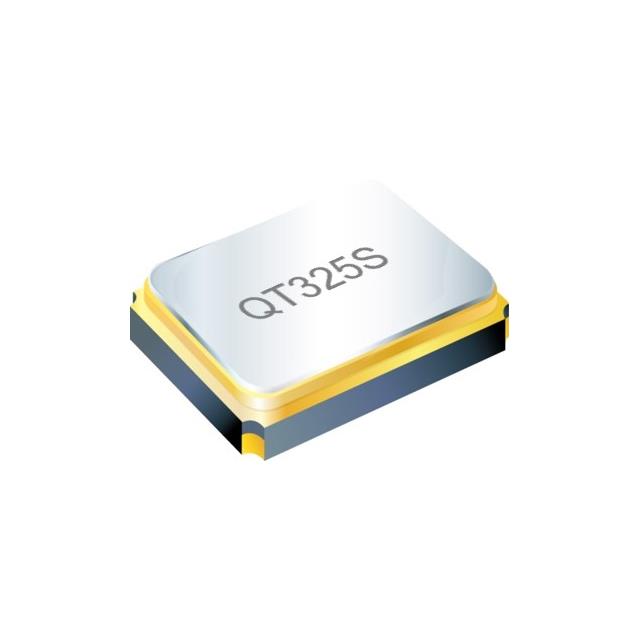
The QT325S-16.000MAHJ-T is a surface-mount quartz crystal resonator manufactured by QST Products LLC, operating at a fundamental frequency of 16 MHz. It features a compact 4-SMD, No Lead package with body dimensions of 3.2 x 2.5 x 0.7 mm. The component exhibits a frequency stability and tolerance of ±30 ppm at 25°C, with an equivalent series resistance (ESR) typically ranging from 50 to 60 Ohms depending on specific manufacturing batches. It supports a load capacitance of 18 pF and operates within a temperature range of -40°C to +85°C. The device is lead-free compliant and designed for high-reliability digital timing applications.
Verify the exact ESR value and temperature range specifications against the official QST datasheet prior to procurement, as values may vary slightly between production lots. Confirm that the 18 pF load capacitance matches the target oscillator circuit design requirements. Ensure the 4-SMD no-lead package compatibility with existing PCB soldering profiles and reflow conditions to prevent mechanical stress or cracking during assembly processes.
Select this component when a 16 MHz reference with ±30 ppm stability is required in a minimal 3.2x2.5mm footprint. Consider the 18 pF load capacitance requirement for oscillator matching networks. Evaluate the -40°C to +85°C operating range against environmental constraints. Compare ESR specifications with alternative crystals if drive level sensitivity or power consumption is critical for the specific application design.
This part belongs to the QT325S series of surface-mount crystals from QST, characterized by small form factors suitable for portable devices. The suffix 'MAHJ' indicates specific packaging and tolerance configurations within the product line. It serves as a direct replacement for other 16 MHz SMD crystals in similar footprints, provided electrical parameters such as load capacitance and ESR are compatible with the host circuit design.
Direct substitutes include other 16 MHz crystals in 3225 packages with matching 18 pF load capacitance and ±30 ppm stability. Verify ESR limits and temperature ranges when cross-referencing with competitors like TXC or NDK. Ensure pinout and physical dimensions remain identical to avoid PCB redesign.
 QT325S-16.000MAHJ-T
The activity of extra discounts on wholesale prices is in full swing…
Please fill in your contact information and we will send you the latest wholesale price list.