ChipApex | Global Electronic Components Supplier
SEARCH
Search Product
Search Post
— IC芯片 | 连接器 | 传感器 | 被动器件 —
Search productSearch post
— IC芯片 | 连接器 | 传感器 | 被动器件 —
Consult the customer manager about the wholesale price.
consultation hotline:86-132-6715-2157
email:[email protected]
Contact the product manager for consultation. One-stop consultation is available.
Do you want a lower wholesale price? Please send us your inquiry and we will reply immediately.
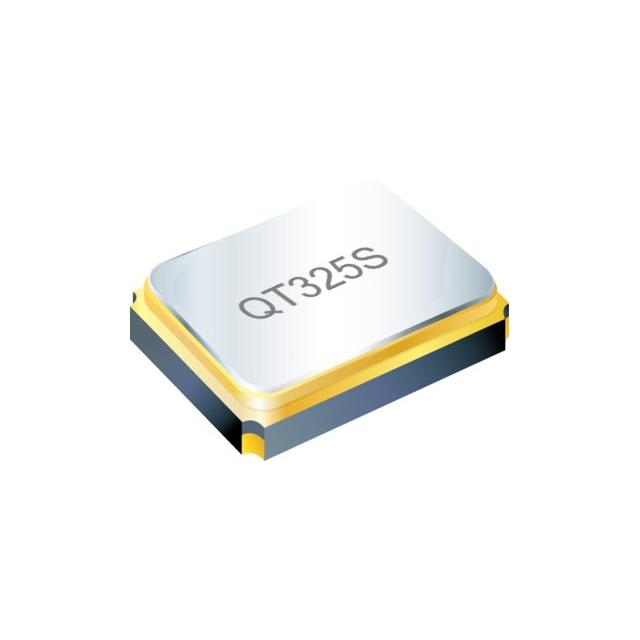
The QST QT325S-16.000MDHJ-T is a miniature surface-mount quartz crystal resonator designed for high-frequency timing applications. It operates at a nominal frequency of 16 MHz with a fundamental parallel mode configuration. The device features a load capacitance of 18 pF and an equivalent series resistance of 60 Ohms. Frequency stability is specified at ±20 ppm within the -20°C to +70°C temperature range, with extended range stability of ±30 ppm from -40°C to +85°C. The component utilizes a 4-SMD, no-lead package with dimensions of 3.2 x 2.5 x 0.7 mm, suitable for automated assembly processes.
Verify the specific suffix code against official QST documentation to confirm temperature range and stability specifications. Ensure compatibility with standard reflow profiles for 4-SMD packages. Confirm RoHS compliance status through manufacturer certificates if required by regulatory standards. Check moisture sensitivity level ratings prior to storage and handling procedures.
Select this component when a 16 MHz fundamental frequency is required with ±20 ppm stability over commercial temperatures. Consider the 18 pF load capacitance for oscillator circuit matching. Evaluate the 3.2 x 2.5 mm footprint against available board space. Compare alternative suffixes if wider operating temperatures or different stability tolerances are necessary for the specific application environment.
This part belongs to the QST QT325S series of miniature SMD crystals. The series offers various frequency options and stability grades defined by alphanumeric suffixes. These components are engineered for portable electronics and industrial equipment where size and reliability are critical. The family supports both fundamental and overtone modes depending on the specific model variant selected.
Direct substitutes include other QST variants within the QT325S series with compatible electrical parameters. Cross-manufacturer replacements must match the 16 MHz frequency, 18 pF load capacitance, and 3.2 x 2.5 mm package dimensions. Verify that alternative parts meet the same ±20 ppm stability requirement over the -20°C to +70°C range.
 QT325S-16.000MDHJ-T
The activity of extra discounts on wholesale prices is in full swing…
Please fill in your contact information and we will send you the latest wholesale price list.