ChipApex | Global Electronic Components Supplier
SEARCH
Search Product
Search Post
— IC芯片 | 连接器 | 传感器 | 被动器件 —
Search productSearch post
— IC芯片 | 连接器 | 传感器 | 被动器件 —
Consult the customer manager about the wholesale price.
consultation hotline:86-132-6715-2157
email:[email protected]
Contact the product manager for consultation. One-stop consultation is available.
Do you want a lower wholesale price? Please send us your inquiry and we will reply immediately.
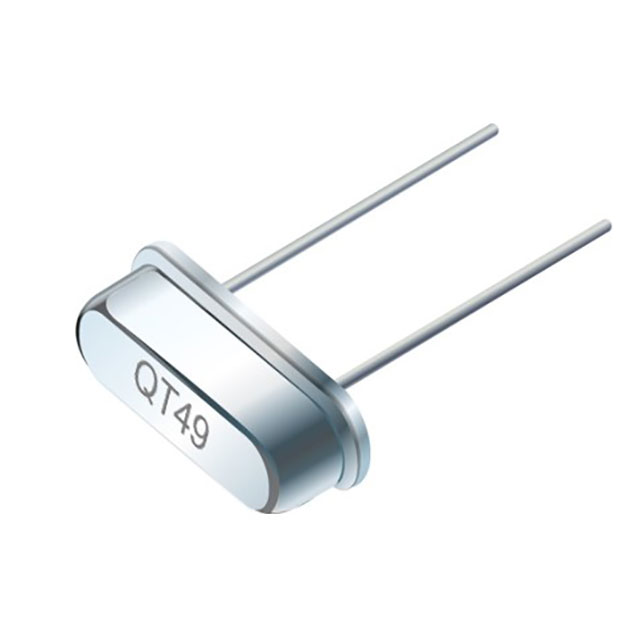
The QT49-25.000MAAJ-B is a through-hole quartz crystal resonator manufactured by QST, operating at a fundamental frequency of 25 MHz. It features a frequency tolerance and stability of ±30 ppm at 25°C and ±30 ppm across the -20°C to +70°C temperature range. The component utilizes an HC-49/US package with dimensions of 11.5 mm in length, 5 mm in width, and 3.68 mm in height. It requires a load capacitance of 18 pF and exhibits a maximum equivalent series resistance (ESR) of 30 Ohms. The device is designed for surface mount or through-hole integration depending on specific board layout requirements.
Verify the exact package variant against the datasheet, as HC-49/U variants may differ in lead configuration or sealing method. Confirm that the 30 Ohm ESR specification aligns with the oscillator circuit design requirements. Ensure the 18 pF load capacitance matches the system's capacitive loading to maintain frequency accuracy. Cross-reference the manufacturer part number with official QST documentation to avoid confusion with similar series components.
Select this component when a standard 25 MHz reference signal is required for digital systems. The HC-49/US form factor offers compatibility with existing through-hole manufacturing processes. Consider the ±30 ppm stability sufficient for non-critical timing applications where higher precision is not mandated. Evaluate the thermal performance to ensure operation remains within the specified -20°C to +70°C range during deployment.
This crystal belongs to the broader family of quartz resonators used for precise timekeeping in electronic circuits. Unlike integrated oscillators, it requires an external driver circuit to sustain oscillation. The HC-49/US style is a legacy but widely adopted package size, ensuring availability across various supply chains. It serves as a passive frequency-determining element rather than an active signal generator.
Substitutes must match the 25 MHz frequency, HC-49/US footprint, and 18 pF load capacitance. Verify that alternative manufacturers offer comparable ±30 ppm stability and 30 Ohm ESR limits. Ensure the replacement part supports the same operating temperature range to maintain system reliability under identical environmental conditions.
 QT49-25.000MAAJ-B
The activity of extra discounts on wholesale prices is in full swing…
Please fill in your contact information and we will send you the latest wholesale price list.