ChipApex | Global Electronic Components Supplier
SEARCH
Search Product
Search Post
— IC芯片 | 连接器 | 传感器 | 被动器件 —
Search productSearch post
— IC芯片 | 连接器 | 传感器 | 被动器件 —
Consult the customer manager about the wholesale price.
consultation hotline:86-132-6715-2157
email:[email protected]
Contact the product manager for consultation. One-stop consultation is available.
Do you want a lower wholesale price? Please send us your inquiry and we will reply immediately.
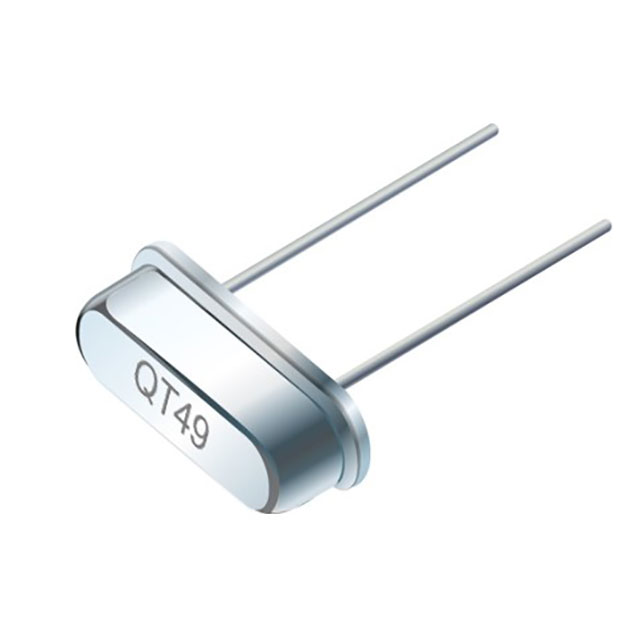
The QST QT49-4.000MAAJ-B is a through-hole MHz crystal resonator operating at a nominal frequency of 4 MHz. It features a frequency stability and tolerance of ±30ppm at 25°C, with an additional stability range of ±30ppm from -20°C to +7°C. The component utilizes a load capacitance of 18pF and exhibits an equivalent series resistance (ESR) of 150 Ohms. Designed for fundamental mode operation, it supports a drive level between 1 and 500μW, typically 100μW. The unit operates within a temperature range of -40°C to +85°C and complies with RoHS3 standards.
Verify the specific package variant, as HC-49/U dimensions may vary slightly between manufacturers. Confirm that the driving circuit impedance matches the 150 Ohm ESR specification to ensure stable oscillation. Ensure the load capacitance requirements of the host circuit align with the 18pF rating. Check environmental compliance documentation if lead-free soldering processes are mandatory for the assembly line.
Select this component when a standard through-hole crystal is required for 4 MHz applications. The HC-49/US form factor ensures compatibility with existing PCB footprints designed for legacy or industrial connectors. Consider the ±30ppm stability limit against the system's jitter requirements. The wide operating temperature range makes it suitable for environments exceeding standard commercial limits.
This part belongs to the QST MHz Crystal product line, specifically utilizing the HC-49/US through-hole package style. It serves as a fundamental frequency reference for digital logic and analog circuits. The QT49 series designation indicates a standard commercial-grade quartz resonator intended for mass production in consumer and industrial electronics where cost-effective timing solutions are prioritized.
Direct substitutes must match the 4 MHz frequency, HC-49/US package, and 18pF load capacitance. Verify ESR compatibility, as values like 50 Ohms or 150 Ohms affect oscillator startup. Ensure the replacement maintains the same frequency stability and temperature range specifications.
 QT49-4.000MAAJ-B
The activity of extra discounts on wholesale prices is in full swing…
Please fill in your contact information and we will send you the latest wholesale price list.