ChipApex | Global Electronic Components Supplier
SEARCH
Search Product
Search Post
— IC芯片 | 连接器 | 传感器 | 被动器件 —
Search productSearch post
— IC芯片 | 连接器 | 传感器 | 被动器件 —
Consult the customer manager about the wholesale price.
consultation hotline:86-132-6715-2157
email:[email protected]
Contact the product manager for consultation. One-stop consultation is available.
Do you want a lower wholesale price? Please send us your inquiry and we will reply immediately.
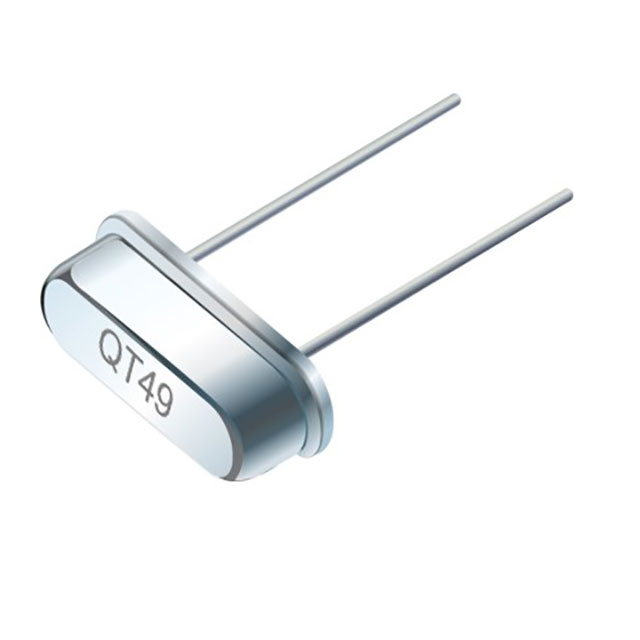
The QT49-48.000MFEQ-B is a through-hole quartz crystal manufactured by QST, operating at a nominal frequency of 48 MHz. It utilizes the HC-49/US package style with dimensions of 11.5 x 5 x 3.68 mm. The component features a load capacitance of 10 pF and an equivalent series resistance (ESR) of 80 Ohms. Frequency stability is specified at ±15 ppm at 25°C and ±10 ppm across the temperature range of -20°C to +70°C.
Verify that the target design supports through-hole assembly processes, as this component requires soldering leads rather than surface mount techniques. Confirm that the PCB footprint matches the HC-49/US mechanical outline to ensure proper physical installation. Check that the circuit oscillator design accounts for the 10 pF load capacitance requirement to achieve the specified frequency accuracy. Ensure the operating environment remains within the -20°C to +70°C range to maintain the stated stability specifications.
Select this part when a reliable, cost-effective timing solution is needed for applications requiring 48 MHz precision. Consider the HC-49/US form factor if space constraints allow for larger components compared to surface-mount alternatives. Evaluate the ±15 ppm stability against system requirements, noting that tighter tolerances may require different series options from the manufacturer. Compare the 80 Ohm ESR with the oscillator circuit's drive level capabilities to prevent over-driving the crystal.
This component belongs to the QT49 series of general-purpose quartz crystals produced by QST. The series offers various frequency and tolerance options packaged in the widely used HC-49/US housing. These crystals are commonly found in consumer electronics and industrial equipment where robust, low-cost timing elements are preferred over more complex oscillator modules.
Substitutes must match the 48 MHz frequency, 10 pF load capacitance, and HC-49/US package dimensions. Verify that alternative parts meet or exceed the ±15 ppm stability at 25°C and ±10 ppm over the temperature range. Ensure the replacement has compatible ESR characteristics to maintain circuit oscillation reliability.
 QT49-48.000MFEQ-B
The activity of extra discounts on wholesale prices is in full swing…
Please fill in your contact information and we will send you the latest wholesale price list.