ChipApex | Global Electronic Components Supplier
SEARCH
Search Product
Search Post
— IC芯片 | 连接器 | 传感器 | 被动器件 —
Search productSearch post
— IC芯片 | 连接器 | 传感器 | 被动器件 —
Consult the customer manager about the wholesale price.
consultation hotline:86-132-6715-2157
email:[email protected]
Contact the product manager for consultation. One-stop consultation is available.
Do you want a lower wholesale price? Please send us your inquiry and we will reply immediately.
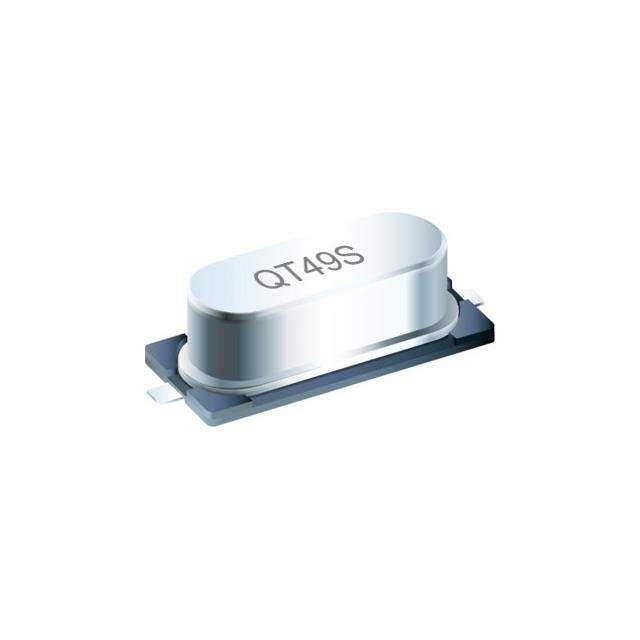
The QT49S-13.560MEEJ-T is a quartz crystal resonator manufactured by QST, designed for precise frequency control in electronic circuits. It operates at a nominal frequency of 13.56 MHz with a tight frequency tolerance of ±10 ppm at 25°C and ±10 ppm across the temperature range of -20°C to +70°C. The component utilizes an HC-49/US package style and features a load capacitance of 18 pF. It exhibits a series resistance of 40 Ohms, ensuring stable oscillation characteristics suitable for RFID and wireless communication applications requiring high frequency stability.
Verify the specific suffix EEEJ against official QST documentation to confirm the exact temperature coefficient and tolerance specifications. Ensure compatibility with existing PCB footprints for HC-49/US packages. Cross-reference the load capacitance requirement of 18 pF with the host oscillator circuit design to maintain frequency accuracy within the stated ±10 ppm limits during procurement validation.
Select this component when strict frequency stability is required for 13.56 MHz operations without significant drift over temperature variations. The HC-49/US package offers robust mechanical protection compared to surface-mount alternatives. Consider the 40 Ohm series resistance when designing drive level constraints to prevent over-driving the crystal. This model is appropriate for applications where long-term frequency aging and environmental stability are critical performance factors.
This part belongs to the QT49S series from QST, which focuses on standard frequency crystals for general-purpose and specialized communication interfaces. The series provides various frequency options and tolerance grades. The QT49S-13.560MEEJ-T specifically targets the industrial ISM band at 13.56 MHz, distinguishing itself from lower-stability variants within the same family by offering tighter ppm tolerances.
Direct substitutes must match the 13.56 MHz frequency, 18 pF load capacitance, HC-49/US package, and ±10 ppm stability. Verify that alternative manufacturers offer equivalent series resistance and temperature range specifications to ensure circuit compatibility without redesign.
 QT49S-13.560MEEJ-T
The activity of extra discounts on wholesale prices is in full swing…
Please fill in your contact information and we will send you the latest wholesale price list.