ChipApex | Global Electronic Components Supplier
SEARCH
Search Product
Search Post
— IC芯片 | 连接器 | 传感器 | 被动器件 —
Search productSearch post
— IC芯片 | 连接器 | 传感器 | 被动器件 —
Consult the customer manager about the wholesale price.
consultation hotline:86-132-6715-2157
email:[email protected]
Contact the product manager for consultation. One-stop consultation is available.
Do you want a lower wholesale price? Please send us your inquiry and we will reply immediately.
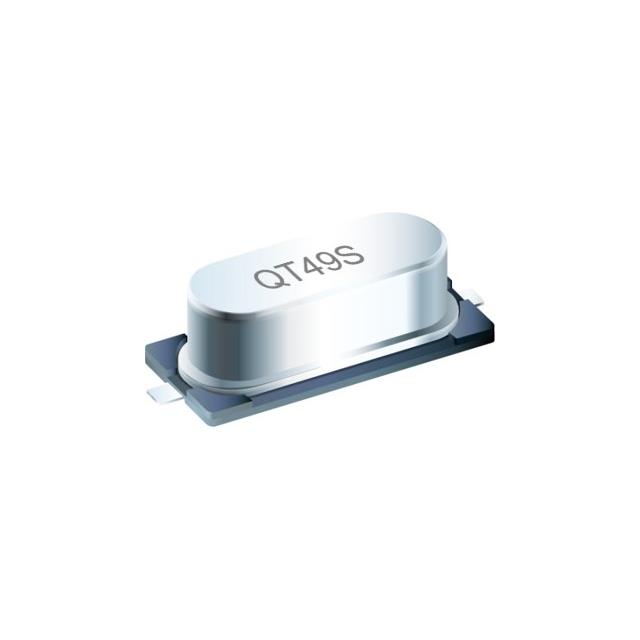
The QT49S-16.9344MBBK-T is a quartz crystal resonator manufactured by QST, operating at a fundamental frequency of 16.9344 MHz. It features a frequency tolerance and stability of ±50 ppm at 25°C, with an equivalent series resistance (ESR) of 30 Ohms maximum. The component utilizes a load capacitance of 20 pF and is housed in an HC-49/US metal can package. The physical dimensions are 11.40 mm in length and 4.80 mm in width, with a seated height of approximately 0.449 inches. This surface-mount compatible device is designed for precision timing applications requiring stable oscillation within standard industrial temperature ranges.
Verify the specific suffix 'BBK' against official QST documentation to confirm lead time and packaging configuration. Ensure the ordering part number matches the required frequency tolerance and ESR specifications. Confirm RoHS compliance status if restricted substances are a constraint for your assembly process. Cross-reference the manufacturer's latest datasheet for any updates on recommended soldering profiles or storage conditions prior to procurement.
Select this component when a 16.9344 MHz reference is required with ±50 ppm stability. The HC-49/US package suits designs needing robust mechanical protection. Consider the 30 Ohm ESR limit to ensure oscillator circuit compatibility. Verify that the 20 pF load capacitance aligns with the host circuit's design requirements. Evaluate thermal performance if operation exceeds standard commercial temperature limits.
This part belongs to the QT49S series from QST, which specializes in high-reliability crystal resonators. The series typically covers frequencies from 3.2 MHz to 90 MHz. The QT49S line emphasizes resistance-welded metal cans for superior hermetic sealing compared to standard epoxy-sealed units. This specific model represents a common frequency used in digital electronics and communication interfaces.
Direct substitutes must match the 16.9344 MHz frequency, HC-49/US package, and ±50 ppm tolerance. Check alternative manufacturers like TXC or NDK for equivalent electrical parameters. Ensure the replacement maintains the same ESR and load capacitance values to prevent oscillator startup failures.
 QT49S-16.9344MBBK-T
The activity of extra discounts on wholesale prices is in full swing…
Please fill in your contact information and we will send you the latest wholesale price list.