ChipApex | Global Electronic Components Supplier
SEARCH
Search Product
Search Post
— IC芯片 | 连接器 | 传感器 | 被动器件 —
Search productSearch post
— IC芯片 | 连接器 | 传感器 | 被动器件 —
Consult the customer manager about the wholesale price.
consultation hotline:86-132-6715-2157
email:[email protected]
Contact the product manager for consultation. One-stop consultation is available.
Do you want a lower wholesale price? Please send us your inquiry and we will reply immediately.
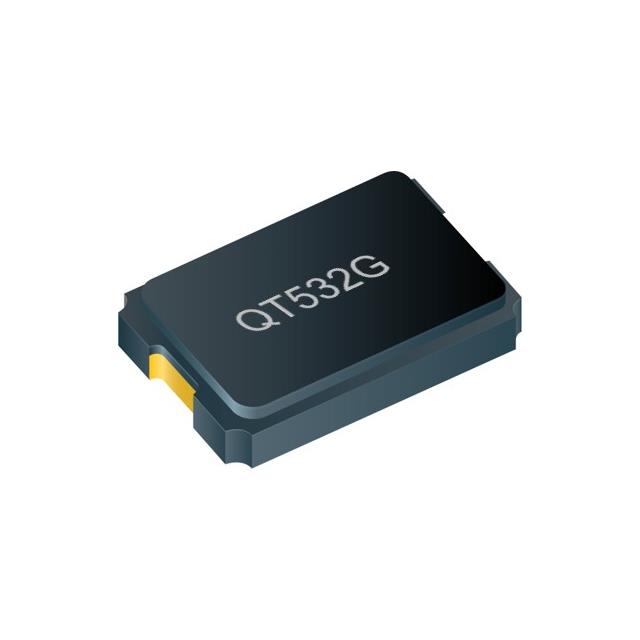
The QT532G-12.288MAHJ-T is a surface-mount crystal oscillator manufactured by QST Products, LLC. It operates at a fundamental frequency of 12.288 MHz with a frequency tolerance and stability of ±30 ppm. The component features a load capacitance of 18 pF and an equivalent series resistance (ESR) of 50 Ohms. It is housed in a 2-SMD, no-lead package measuring 5.0 mm x 3.2 mm. The device supports an operating temperature range from -40°C to +85°C and complies with RoHS standards.
Verify the manufacturer designation carefully, as this part number appears associated with both QST Products, LLC and TXC Corporation in various listings. Confirm the specific datasheet version and package dimensions (5.0x3.2mm vs 3.2x2.5mm) match your design requirements before ordering. Ensure compliance with RoHS directives and check for any regional distribution restrictions or discontinuation notices that may affect availability.
Select this component when a 12.288 MHz reference is required for baud rate compatibility in serial communications. The ±30 ppm tolerance suits applications where moderate frequency accuracy is sufficient. Consider the 18 pF load capacitance requirement to ensure proper oscillation circuit design. Evaluate the 50 Ohm ESR against the oscillator circuit's drive level specifications to prevent overdriving the crystal.
This crystal belongs to the QT532G series, which offers surface-mount solutions for timing applications. It serves as a passive resonator element integrated into active oscillator circuits or used directly in MCU clock inputs. The 12.288 MHz frequency is commonly chosen for its divisibility into standard serial communication baud rates, facilitating reliable data transmission in embedded systems.
Direct substitutes include other 12.288 MHz crystals with similar ±30 ppm tolerance and 18 pF load capacitance. Verify package compatibility, noting potential differences between 5.0x3.2mm and 3.2x2.5mm footprints. Cross-reference with TXC 7V-12.288MAGJ-T if dimensional changes are acceptable, but confirm electrical parameters match the original design constraints.
 QT532G-12.288MAHJ-T
The activity of extra discounts on wholesale prices is in full swing…
Please fill in your contact information and we will send you the latest wholesale price list.