ChipApex | Global Electronic Components Supplier
SEARCH
Search Product
Search Post
— IC芯片 | 连接器 | 传感器 | 被动器件 —
Search productSearch post
— IC芯片 | 连接器 | 传感器 | 被动器件 —
Consult the customer manager about the wholesale price.
consultation hotline:86-132-6715-2157
email:[email protected]
Contact the product manager for consultation. One-stop consultation is available.
Do you want a lower wholesale price? Please send us your inquiry and we will reply immediately.
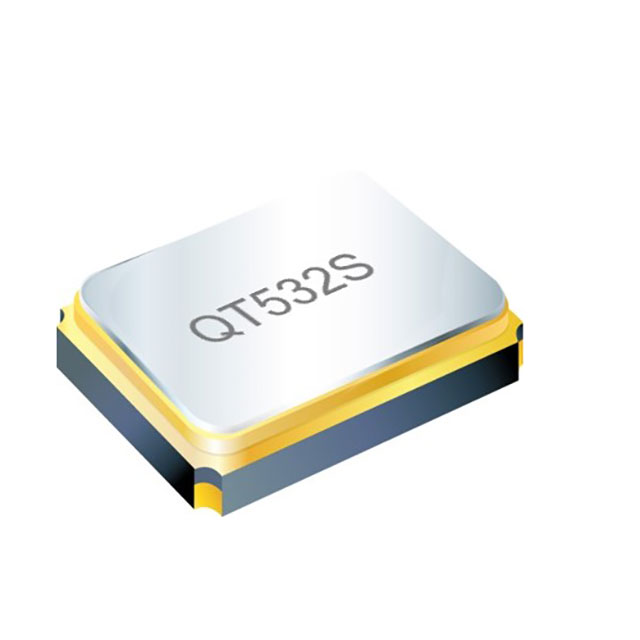
The QT532S-26.000MAGE-T is a surface-mount quartz crystal resonator manufactured by QST, designed for precise frequency generation in electronic circuits. Operating at a fundamental frequency of 26 MHz, this component provides stable timing signals with a frequency stability of ±50 ppm and a tolerance of ±30 ppm at 25°C. It features a load capacitance of 12 pF and an equivalent series resistance (ESR) of 40 Ohms. The device is housed in a compact 4-SMD, No Lead package with dimensions of 5.0 mm x 3.2 mm x 0.9 mm. It supports a wide operating temperature range from -20°C to +70°C and is RoHS compliant.
Verify the specific suffix MAGE-T against official QST documentation to confirm the exact stability and tolerance ratings, as suffix variations often denote different performance grades. Ensure the selected variant matches the required load capacitance and ESR specifications for the target circuit design. Cross-reference the package dimensions to confirm compatibility with existing PCB footprints and manufacturing equipment capabilities.
Select this component when a 26 MHz fundamental frequency is required with moderate stability requirements. The 12 pF load capacitance must match the oscillator circuit's input capacitance settings. Consider the ±50 ppm stability limit for applications sensitive to long-term drift. The 40 Ohm ESR value should be compatible with the driving strength of the host oscillator IC to ensure reliable startup.
This part belongs to the QT532S series of surface-mount crystals from QST. The series offers various frequencies and package options tailored for consumer and industrial electronics. The QT532S form factor is widely used in portable devices due to its small footprint and robust mechanical characteristics compared to larger through-hole alternatives.
Direct substitutes include other 26 MHz SMD crystals with matching 12 pF load capacitance and similar ESR values. Verify that alternative parts support the same 4-SMD no-lead package dimensions to ensure mechanical fit. Check if competitor components offer improved stability or temperature ranges if the current ±50 ppm specification is insufficient for the application.
 QT532S-26.000MAGE-T
The activity of extra discounts on wholesale prices is in full swing…
Please fill in your contact information and we will send you the latest wholesale price list.