 ChipApex | Global Electronic Components Supplier
SEARCH
Search Product
Search Post
— IC芯片 | 连接器 | 传感器 | 被动器件 —
Search productSearch post
— IC芯片 | 连接器 | 传感器 | 被动器件 —
Consult the customer manager about the wholesale price.
consultation hotline:86-132-6715-2157
email:[email protected]
Contact the product manager for consultation. One-stop consultation is available.
Do you want a lower wholesale price? Please send us your inquiry and we will reply immediately.
The QT60040-IS is a CMOS charge-transfer sensor IC designed for matrix touch controls, supporting up to four keys in a 4x1 configuration. It operates on a single power supply ranging from 2.5V to 5.5V with a typical supply current of 0.6mA at 3V and 1.5mA at 5V. The device features four active-high outputs capable of sensing up to two simultaneous key presses. It includes built-in self-calibration, drift compensation, and detection integration counters to ensure stability. The component is housed in a 14-pin SOIC package and supports an operating temperature range of -40°C to +85°C.
Verify the specific suffix 'IS' confirms the 14-pin SOIC package and extended industrial temperature range (-40°C to +85°C). Ensure the design accommodates the required 2.5V to 5.5V regulated supply voltage. Confirm that the application environment does not exceed the absolute maximum pin current limits of ±20mA. Check datasheet specifications for ESD protection requirements if exposed terminals are anticipated.
Select this component when a low-component-count solution for multi-key capacitive sensing is required. It is suitable for applications needing robust performance under varying environmental conditions without manual calibration. Consider the 14-pin SOIC package constraints for PCB layout. Evaluate the need for simultaneous dual-key sensing versus single-key locking based on system logic requirements.
The QT60040 belongs to the Quantum Research Group's QT (charge-transfer) family of sensors. It utilizes patented transverse charge-transfer methods to minimize scan lines and external components compared to older technologies. This approach allows for cost-effective designs using common PCB materials without requiring custom molded membranes or exotic fabrication techniques.
The QT60040-D serves as the commercial grade alternative, offering identical functionality but limited to a 0°C to +70°C operating temperature range. Verify that the thermal requirements of the target application align with the specific temperature rating of the selected variant before substitution.
The device employs an asymmetric drift compensation algorithm that tracks raw signals slowly while no detection occurs. It compensates faster for decreasing loads to allow quick recovery and slower for increasing loads to maintain sensitivity to approaching fingers.
Sensitivity is primarily determined by the value of the single external sampling capacitor (Cs), which typically ranges from 22nF to 220nF. Key geometry, panel material thickness, and electrode design also significantly influence the final sensitivity levels.
Yes, the default configuration allows sensing any two keys at the same time. This can be restricted to sense only one key at a time by connecting the OPT1 pin to ground.
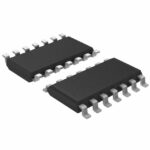 QT60040-IS
The activity of extra discounts on wholesale prices is in full swing…
Please fill in your contact information and we will send you the latest wholesale price list.





