ChipApex | Global Electronic Components Supplier
SEARCH
Search Product
Search Post
— IC芯片 | 连接器 | 传感器 | 被动器件 —
Search productSearch post
— IC芯片 | 连接器 | 传感器 | 被动器件 —
Consult the customer manager about the wholesale price.
consultation hotline:86-132-6715-2157
email:[email protected]
Contact the product manager for consultation. One-stop consultation is available.
Do you want a lower wholesale price? Please send us your inquiry and we will reply immediately.
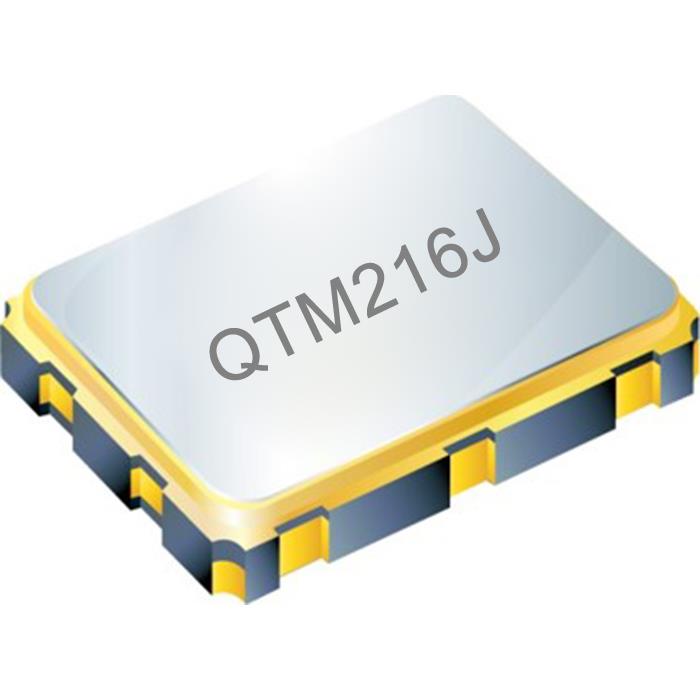
The QTM216J-48.000MDJ-T is a standard CMOS quartz oscillator manufactured by QST, operating at a frequency of 48 MHz. It features a 1.8V supply voltage with enable/disable functionality and provides a frequency stability of ±50ppm. The device utilizes a crystal as its basic resonator and is housed in a compact 4-SMD, no lead package measuring 2.0mm x 1.6mm. Designed for surface mount installation, it supports an operating temperature range from -40°C to 105°C, ensuring reliable performance in demanding industrial environments.
Verify the specific suffix 'MDJ' against the manufacturer's current datasheet to confirm the exact frequency tolerance and temperature range specifications. Ensure the ordering quantity aligns with the tape and reel packaging requirements specified by the distributor. Cross-reference the part number with the latest revision history to avoid discrepancies in electrical parameters or pinout definitions during procurement.
Select this component when a low-profile 48MHz clock source is required for 1.8V logic systems. The ±50ppm stability suits general digital applications where tight jitter constraints are not critical. Consider the enable feature if power conservation is necessary. Evaluate the 105°C upper limit against the specific thermal environment of the target application to ensure long-term reliability under operational stress.
This oscillator belongs to the QTM216 series, characterized by its small 2.0x1.6mm ceramic package. The series offers various frequencies and voltage options, catering to diverse embedded design needs. The J variant typically denotes specific commercial/industrial grade specifications within the product line, providing a balance between cost and performance for mass-produced electronic devices.
Direct replacements include other 48MHz 1.8V CMOS oscillators in 2016 packages from manufacturers like TXC or SiTime. Verify pin compatibility and output waveform integrity before substitution. Ensure the alternative part meets the same ±50ppm stability and -40°C to 105°C temperature range requirements for equivalent performance.
 QTM216J-48.000MDJ-T
The activity of extra discounts on wholesale prices is in full swing…
Please fill in your contact information and we will send you the latest wholesale price list.