ChipApex | Global Electronic Components Supplier
SEARCH
Search Product
Search Post
— IC芯片 | 连接器 | 传感器 | 被动器件 —
Search productSearch post
— IC芯片 | 连接器 | 传感器 | 被动器件 —
Consult the customer manager about the wholesale price.
consultation hotline:86-132-6715-2157
email:[email protected]
Contact the product manager for consultation. One-stop consultation is available.
Do you want a lower wholesale price? Please send us your inquiry and we will reply immediately.
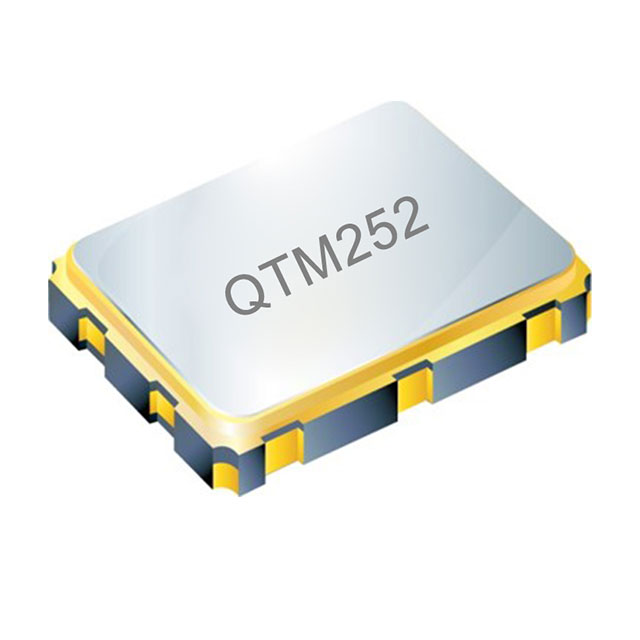
The QTM252-30.000MBE-T is a standard CMOS quartz oscillator manufactured by TXC Corporation, housed in a compact 2.5x2.0 mm ceramic package. It operates at a nominal frequency of 30.000 MHz with a supply voltage range supporting 1.8V, 2.5V, and 3.3V levels. The device features a frequency stability of ±50ppm across an industrial temperature range of -40°C to +85°C. It exhibits a maximum RMS phase jitter of 1ps within specified integration bandwidths and includes a three-state enable/disable control pin for power management. The output current is limited to a maximum of 10mA, with a startup time of up to 5ms.
Verify the specific suffix codes on the component marking against official datasheets to confirm voltage tolerance and temperature grade. Ensure that the supply voltage applied matches the selected variant's rating to prevent damage. Confirm that the enable pin circuitry correctly handles the logic thresholds for low-power states. Check for RoHS compliance documentation if environmental regulations apply to the final assembly.
Select this oscillator when a small footprint and low jitter are critical for system performance. Consider the ±50ppm stability sufficient for general consumer applications where tighter tolerances are not required. Evaluate the three-state feature benefits for battery-powered devices needing efficient sleep modes. Compare against higher stability variants if long-term aging or extreme temperature variations impact system accuracy requirements.
This component belongs to the QTM252 series of surface-mount crystal oscillators designed for timing applications. The series offers various frequency options within the 4MHz to 125MHz range, catering to diverse digital interface needs. Manufactured by TXC Corporation under the QST brand, these oscillators provide reliable clock signals for modern electronic systems requiring precision timing in minimal space.
Direct substitutes include other models from the QTM252 family with matching frequencies and package dimensions. Verify compatibility regarding supply voltage ranges and enable pin logic levels before swapping. Cross-reference part numbers ending in different suffixes to ensure identical electrical characteristics and thermal specifications.
 QTM252-30.000MBE-T
The activity of extra discounts on wholesale prices is in full swing…
Please fill in your contact information and we will send you the latest wholesale price list.