ChipApex | Global Electronic Components Supplier
SEARCH
Search Product
Search Post
— IC芯片 | 连接器 | 传感器 | 被动器件 —
Search productSearch post
— IC芯片 | 连接器 | 传感器 | 被动器件 —
Consult the customer manager about the wholesale price.
consultation hotline:86-132-6715-2157
email:[email protected]
Contact the product manager for consultation. One-stop consultation is available.
Do you want a lower wholesale price? Please send us your inquiry and we will reply immediately.
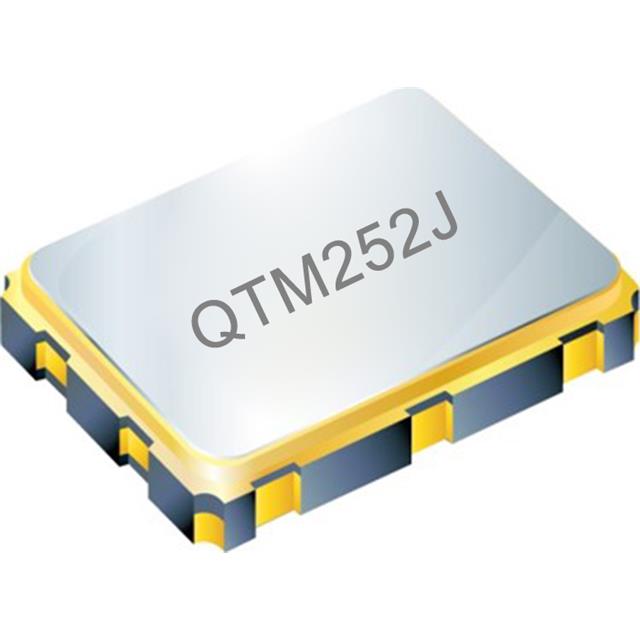
The QTM252J-1.8432MDJ-T is a standard clock oscillator manufactured by TXC Corporation, operating at a frequency of 1.8432 MHz. It utilizes CMOS output logic and requires a 1.8V supply voltage. The device features a frequency stability of ±50 ppm across an operating temperature range of -40°C to +105°C. It is housed in a compact 4-SMD, No Lead package with dimensions of 2.5mm x 2.0mm. The component includes enable/disable functionality and is supplied in reels of 3000 units.
Verify the manufacturer designation carefully, as this part number is associated with TXC Corporation despite the requested brand query. Confirm the specific suffix 'MDJ' corresponds to the 1.8V supply and ±50ppm stability requirements. Ensure the order quantity aligns with the standard reel packaging configuration provided by the supplier. Cross-reference the datasheet for pinout compatibility before integration.
Select this component when a low-profile 2.5x2.0mm footprint is required for 1.8V CMOS clocking applications. The wide industrial temperature range supports operation in demanding environments. Consider the enable/disable feature if power management or clock gating is necessary within the system architecture. Verify that the load capacitance requirements match the target circuit design specifications.
This oscillator belongs to the QTM252J series, which offers various frequency options within the same physical package. The series provides standardized timing solutions for consumer electronics and industrial controls. Competing products typically offer similar form factors but may differ in electrical specifications or supply voltage ranges. The model represents a specific frequency variant within this broader family of quartz ceramic oscillators.
Direct substitutes include other models from the QTM252J series with different frequencies, such as QTM252J-1.8432MDE-T, though supply voltage variations must be checked. Generic replacements require matching the 4-SMD package, 1.8V operation, and CMOS output type. Always verify frequency stability and temperature range compliance when substituting.
 QTM252J-1.8432MDJ-T
The activity of extra discounts on wholesale prices is in full swing…
Please fill in your contact information and we will send you the latest wholesale price list.