ChipApex | Global Electronic Components Supplier
SEARCH
Search Product
Search Post
— IC芯片 | 连接器 | 传感器 | 被动器件 —
Search productSearch post
— IC芯片 | 连接器 | 传感器 | 被动器件 —
Consult the customer manager about the wholesale price.
consultation hotline:86-132-6715-2157
email:[email protected]
Contact the product manager for consultation. One-stop consultation is available.
Do you want a lower wholesale price? Please send us your inquiry and we will reply immediately.
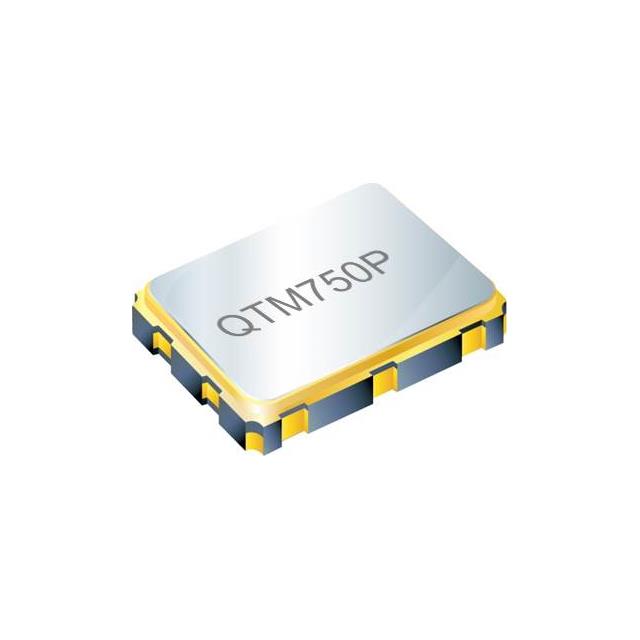
The QTM750P-100.000MBE-T is a standard clock oscillator manufactured by QST, designed for high-frequency digital applications. It operates at a nominal frequency of 100 MHz with a stability of ±50 ppm across the industrial temperature range of -40°C to +85°C. The device utilizes LVPECL output format and requires a single 3.3V DC power supply. Housed in a compact 6-SMD, No Lead package measuring 7.0mm x 5.0mm x 1.3mm, it integrates quartz crystal technology within a ceramic body. This component provides precise timing signals suitable for data communication systems and high-speed processing circuits.
Verify the specific suffix 'BE' against official manufacturer documentation to confirm the exact output configuration and voltage compatibility. Ensure that the receiving circuitry supports the LVPECL signal levels provided by this oscillator. Cross-reference the package dimensions and pinout with the target design specifications to guarantee mechanical fit and electrical connectivity before finalizing procurement orders.
Select this component when a 100 MHz frequency is required alongside LVPECL outputs for superior signal integrity in high-speed designs. Consider the ±50 ppm stability specification for applications sensitive to timing jitter. Evaluate the 3.3V supply requirement against available system voltages. The compact SMD form factor makes it suitable for space-constrained layouts where traditional through-hole oscillators cannot be accommodated.
This part belongs to the QTM750P series of standard oscillators from QST, which are engineered for robust performance in demanding electronic environments. The series typically offers various frequency options while maintaining consistent package dimensions and electrical characteristics. The P-series designation often indicates specific packaging or enable features compared to standard variants, providing designers with flexibility for different application requirements.
The QTM750P-100.000MBD-T serves as a potential substitute within the same product family, though verification of the output suffix difference is mandatory. Ensure that any replacement maintains the LVPECL output format and identical frequency stability specifications. Confirm that the physical footprint remains compatible with existing PCB footprints to avoid rework.
 QTM750P-100.000MBE-T
The activity of extra discounts on wholesale prices is in full swing…
Please fill in your contact information and we will send you the latest wholesale price list.