ChipApex | Global Electronic Components Supplier
SEARCH
Search Product
Search Post
— IC芯片 | 连接器 | 传感器 | 被动器件 —
Search productSearch post
— IC芯片 | 连接器 | 传感器 | 被动器件 —
Consult the customer manager about the wholesale price.
consultation hotline:86-132-6715-2157
email:[email protected]
Contact the product manager for consultation. One-stop consultation is available.
Do you want a lower wholesale price? Please send us your inquiry and we will reply immediately.
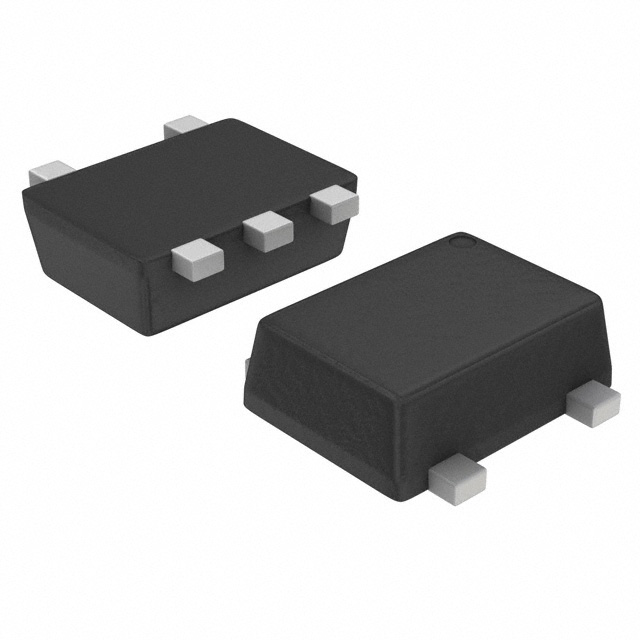
The RN1705JE(TE85L,F) is a dual NPN epitaxial planar Bias Resistor Built-in Transistor (BRIT) manufactured by Toshiba Semiconductor and Storage. It integrates two transistors into an Extreme-Super-Mini 5-pin package, featuring internal bias resistors to reduce component count. Key electrical parameters include a collector-emitter voltage of 50 V, continuous collector current of 100 mA, and power dissipation of 100 mW. The device incorporates a 2.2 kΩ base resistor (R1) and a 47 kΩ emitter resistor (R2), with a minimum DC current gain of 80 at 10 mA. Transition frequency reaches 250 MHz, and it operates within a junction temperature range of -55°C to 150°C.
Verify the specific ordering suffix TE85L,F against official Toshiba documentation to confirm packaging type and lead-free status. Ensure compliance with RoHS directives as indicated in manufacturer specifications. Review the Toshiba Semiconductor Reliability Handbook for derating guidelines before finalizing procurement plans.
Select this component when a dual NPN digital transistor with asymmetric bias resistors is required. The 2.2 kΩ input resistance suits low-current drive applications. Verify that the 100 mW power dissipation rating accommodates thermal constraints in the target enclosure design.
This part belongs to the RN1701JE through RN1706JE series of NPN BRITs. All members share identical pinouts and maximum ratings but differ in internal resistor values. The RN1705JE specifically provides a 2.2 kΩ R1 value, distinguishing it from other variants in the family.
Complementary PNP equivalents are available in the RN2701JE to RN2706JE series. Direct substitution requires verifying matching resistor ratios and ensuring polarity compatibility within the circuit topology.
The RN1705JE contains a base resistor (R1) of 2.2 kΩ and an emitter resistor (R2) of 47 kΩ.
The absolute maximum rating for collector-emitter voltage (VCEO) is 50 V.
The resistor ratio (R1/R2) is typically 0.0468, influencing the input impedance and saturation characteristics during switching operations.
 RN1705JE(TE85L,F)
The activity of extra discounts on wholesale prices is in full swing…
Please fill in your contact information and we will send you the latest wholesale price list.