ChipApex | Global Electronic Components Supplier
SEARCH
Search Product
Search Post
— IC芯片 | 连接器 | 传感器 | 被动器件 —
Search productSearch post
— IC芯片 | 连接器 | 传感器 | 被动器件 —
Consult the customer manager about the wholesale price.
consultation hotline:86-132-6715-2157
email:[email protected]
Contact the product manager for consultation. One-stop consultation is available.
Do you want a lower wholesale price? Please send us your inquiry and we will reply immediately.
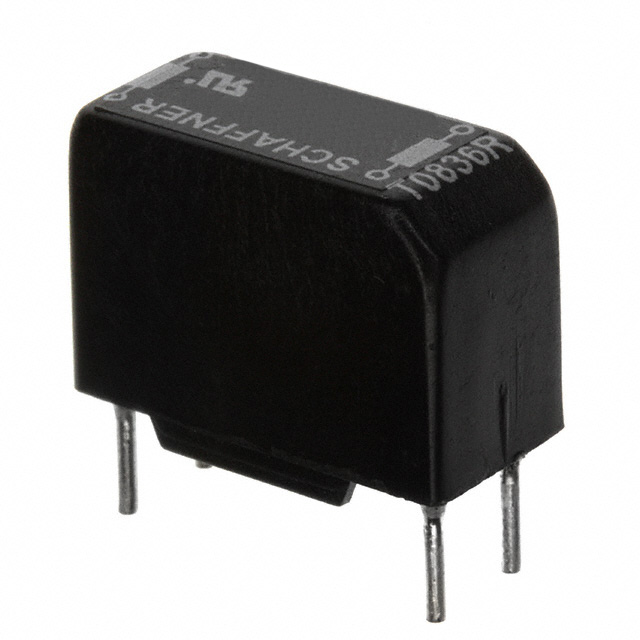
The Schaffner RN202-2-02-1M1 is a current compensated common mode choke designed for power line applications. It features an inductance of 1.1 mH at a test frequency of 10 kHz and supports a maximum DC current of 2 A. The component exhibits a maximum DC resistance of 70 mOhms with a tolerance range of -30% to +50%. Constructed with ferrite core material, it utilizes a vertical through-hole mounting style with four pins. The physical dimensions are 18.2 mm in length, 8.8 mm in width, and 13.5 mm in height. It operates within a temperature range of -40°C to +100°C.
Verify the manufacturer part number RN202-2-02-1M1 against official TE Connectivity or Schaffner documentation to ensure authenticity. Confirm that the component meets required RoHS compliance standards and matches specified electrical parameters, including 1.1 mH inductance and 2 A current rating. Check for any specific ordering suffixes that may alter functional characteristics before finalizing procurement.
Select this component when a two-line power filter with 1.1 mH inductance and 2 A current capacity is required. Ensure the PCB layout accommodates the 18.2 mm x 8.8 mm footprint and vertical orientation. Verify that the operating environment stays within the -40°C to +100°C temperature range and that the unshielded design does not interfere with adjacent sensitive components.
This component belongs to the RN series of common mode chokes manufactured by TE Connectivity / Schaffner. It is categorized under inductors, chokes, and coils, specifically designed as a current compensated choke for vertical PCB mounting. The product serves as a passive filter element for mitigating common mode noise in power distribution networks.
RN202-0.3-02-22M offers similar vertical through-hole mounting but differs significantly in current rating (0.3 A) and inductance (22 mH). RN212-2-02-1M8 provides comparable 2 A current handling but features higher inductance (1.8 mH) and distinct physical dimensions. Cross-reference datasheets to confirm electrical compatibility before substitution.
 RN202-2-02-1M1
The activity of extra discounts on wholesale prices is in full swing…
Please fill in your contact information and we will send you the latest wholesale price list.