 ChipApex | Global Electronic Components Supplier
SEARCH
Search Product
Search Post
— IC芯片 | 连接器 | 传感器 | 被动器件 —
Search productSearch post
— IC芯片 | 连接器 | 传感器 | 被动器件 —
Consult the customer manager about the wholesale price.
consultation hotline:86-132-6715-2157
email:[email protected]
Contact the product manager for consultation. One-stop consultation is available.
Do you want a lower wholesale price? Please send us your inquiry and we will reply immediately.
The RN2903,LF(CT is a dual PNP digital transistor array manufactured by Toshiba Semiconductor and Storage. It integrates two pre-biased transistors within a compact US6 surface-mount package (equivalent to SC-88 or SOT-363). The device features a collector-emitter breakdown voltage of 50V and a maximum continuous collector current of 100mA per element. Internal biasing resistors are configured with R1 at 2.2 kΩ and R2 at 47 kΩ. Key electrical specifications include a DC current gain (hFE) of 80 minimum at 10mA and 5V, a saturation voltage of 300mV maximum at 250µA base current and 5mA collector current, and a transition frequency of 200MHz. Power dissipation is rated at 200mW.
Verify the specific ordering suffix against the manufacturer's latest datasheet to ensure correct packaging and tape-and-reel specifications. Confirm RoHS compliance status and moisture sensitivity level requirements prior to procurement. Cross-reference the full part number including any trailing characters with official distributor catalogs to avoid discrepancies in component variants.
Select this component when a dual PNP configuration with fixed internal biasing is required to reduce external component count. Ensure the 50V voltage rating and 100mA current capacity meet the load requirements. Verify that the 2.2kΩ input resistance aligns with the driving source impedance and logic levels. Consider the US6 package dimensions for board space constraints compared to alternative packages.
The RN2903 belongs to Toshiba's RN series of digital transistors, which combine BJTs with integrated biasing networks. This series is designed to replace multiple discrete components, simplifying schematic design and reducing assembly costs. The RN2903 specifically offers a dual PNP configuration, contrasting with single-transistor or NPN-only variants within the same product family.
The RN1904 is listed as a substitute part number in available documentation. Verify pin compatibility and electrical parameter equivalence before implementation.
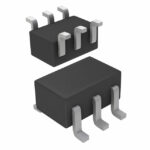 RN2903,LF(CT
The activity of extra discounts on wholesale prices is in full swing…
Please fill in your contact information and we will send you the latest wholesale price list.




