 ChipApex | Global Electronic Components Supplier
SEARCH
Search Product
Search Post
— IC芯片 | 连接器 | 传感器 | 被动器件 —
Search productSearch post
— IC芯片 | 连接器 | 传感器 | 被动器件 —
Consult the customer manager about the wholesale price.
consultation hotline:86-132-6715-2157
email:[email protected]
Contact the product manager for consultation. One-stop consultation is available.
Do you want a lower wholesale price? Please send us your inquiry and we will reply immediately.
The RN4982,LXHF(CT is an automotive-grade digital transistor manufactured by Toshiba Semiconductor and Storage. It integrates one NPN and one PNP pre-biased transistor in a single US-6 (SOT-363) surface-mount package. The device features a collector-emitter voltage (VCEO) of 50 V, a continuous collector current (IC) of 100 mA, and a power dissipation (Pd) of 200 mW. Internal bias resistors are configured with R1 at 10 kOhms and R2 at 10 kOhms. It meets AEC-Q101 qualification standards for automotive applications, supports a maximum operating temperature of +150°C, and offers transition frequencies up to 250 MHz.
Verify the complete part number including the LXHF suffix to ensure correct packaging and automotive qualification status. Confirm RoHS compliance details through official Toshiba documentation prior to procurement. Cross-reference the manufacturer part number with authorized distributor catalogs to validate authenticity and traceability. Ensure storage conditions align with moisture sensitivity level requirements specified in the datasheet.
Select this component when a dual NPN/PNP digital transistor solution is required for space-constrained automotive designs. The integrated 10kOhm bias resistors reduce external component count compared to discrete transistor arrangements. Verify that the 50V voltage rating and 100mA current capacity meet the specific load requirements of the target application circuit.
This component belongs to the RN49xx series of pre-biased digital transistors from Toshiba. The series provides various resistor combinations within standardized packages like SOT-363 and SOT-563. The LXHF suffix typically denotes specific packaging and environmental compliance attributes defined by the manufacturer for automotive supply chains.
The RN4985,LXHF(CT serves as a functional substitute within the same family, though it utilizes different internal resistor values (R1=2.2kOhm, R2=47kOhm). Designers must verify that the alternative resistor ratios do not alter the intended biasing or switching characteristics of the original circuit.
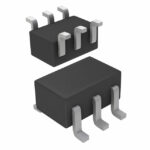 RN4982,LXHF(CT
The activity of extra discounts on wholesale prices is in full swing…
Please fill in your contact information and we will send you the latest wholesale price list.




