ChipApex | Global Electronic Components Supplier
SEARCH
Search Product
Search Post
— IC芯片 | 连接器 | 传感器 | 被动器件 —
Search productSearch post
— IC芯片 | 连接器 | 传感器 | 被动器件 —
Consult the customer manager about the wholesale price.
consultation hotline:86-132-6715-2157
email:[email protected]
Contact the product manager for consultation. One-stop consultation is available.
Do you want a lower wholesale price? Please send us your inquiry and we will reply immediately.
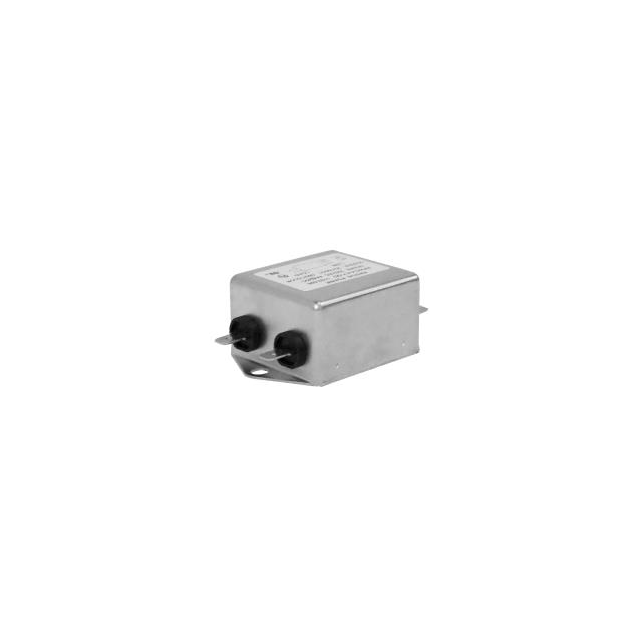
The Astrodyne TDI RP210-6-.47-W is a single-phase, two-stage power line filter designed for chassis mounting. It features a rated voltage of 250 VAC and a current rating of 6 A. The component utilizes tab connectors for termination and includes a capacitance value of 470 pF (0.47 nF). Designed for operation at 50 Hz and 60 Hz frequencies, it exhibits a leakage current of 80 uA. The unit measures 51 mm in length and 29 mm in height. Compliance certifications include cURus and EN60939 standards.
Verify the specific suffix 'W' against manufacturer documentation to confirm exact packaging or variant details, as suffixes can denote specific handling or compliance nuances. Ensure the tab connector type matches the PCB or terminal block interface requirements. Confirm that the 6 A current rating and 250 VAC voltage limits align with the system's operational parameters. Check for updated compliance certificates such as cURus and EN60939 before finalizing procurement.
Select this model when a compact, two-stage EMI filter is required for low-current AC applications. The 6 A rating distinguishes it from higher-capacity single-stage alternatives like the RP130 series. The low leakage current of 80 uA makes it preferable over high-leakage variants for safety-critical environments. Consider the tab connector style versus quick-connect or stud options based on assembly constraints.
This component belongs to the RP210 series, which focuses on dual-stage filtration for improved performance in space-constrained designs. Unlike the RP220 series, which offers higher capacitance values, the RP210 series prioritizes lower leakage and compact form factors. It serves as a specialized solution within Astrodyne TDI's portfolio for applications requiring stringent EMI suppression without excessive size.
Publicly confirmed direct substitute part numbers are not available in the provided documentation. For equivalent specifications, consider the RP220-6-4.7-QD for higher capacitance or the RP135-6-4.7-QD for single-stage alternatives, though these differ in stage count, leakage current, and termination style.
 RP210-6-.47-W
The activity of extra discounts on wholesale prices is in full swing…
Please fill in your contact information and we will send you the latest wholesale price list.