 ChipApex | Global Electronic Components Supplier

SEARCH
Search Product
Search Post
Search productSearch post
Consult the customer manager about the wholesale price.
consultation hotline:86-132-6715-2157
email:[email protected]
Contact the product manager for consultation. One-stop consultation is available.
Do you want a lower wholesale price? Please send us your inquiry and we will reply immediately.
SBCT1020 is listed in the Diode Arrays range at ChipApex. The manufacturer field lists Diotec Semiconductor. Its product description is DIODE ARR SCHOTT 20V 5A TO-220AB. Review the specifications below when checking this part for your BOM.
The SBCT1020 is a Schottky Barrier Rectifier Diode manufactured by Diotec Semiconductor. It features a dual common cathode configuration with a total average forward current rating of 10 A (5 A per diode). The device has a maximum repetitive peak reverse voltage of 20 V and a typical junction-to-case thermal resistance of 3.0 K/W. Electrical characteristics include a maximum forward voltage of 0.55 V at 5 A and 0.63 V at 10 A, both measured at a junction temperature of 25°C. The component supports a peak forward surge current of up to 120 A at 60 Hz and operates within a junction temperature range of -50°C to +150°C.
Verify the specific ordering code against the manufacturer's official documentation to ensure correct pinout and electrical ratings. Confirm that the procurement channel provides genuine components from Diotec Semiconductor AG. Check for any specific packaging requirements or environmental compliance certifications required for your assembly process before placing orders.
Select this component when a dual rectifier solution is required with a 20 V reverse voltage rating and a combined 10 A current capacity. Ensure the application design accounts for the thermal resistance of 3.0 K/W to maintain junction temperatures within the specified limits under expected load conditions.
This part belongs to the SBCT10xx series of Schottky Barrier Rectifiers from Diotec Semiconductor. The series offers various voltage ratings while maintaining consistent current capabilities and package dimensions, allowing for design flexibility across different power supply architectures without changing the physical footprint.
Direct substitutes must match the dual common cathode configuration, 20 V reverse voltage, and 10 A total current rating. Verify equivalent thermal resistance and forward voltage characteristics to ensure performance parity in existing designs.
The maximum repetitive peak reverse voltage (VRRM) is 20 V.
The device has a total average forward current (IFAV) of 10 A, distributed as 5 A per diode in the dual common cathode configuration.
The typical junction capacitance (Cj) is 300 pF, measured at a reverse voltage of 4 V.
Explore related parts through Rectifiers, Diodes, Discrete Semiconductor Products, all product categories.
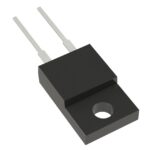 SBCT1020

The activity of extra discounts on wholesale prices is in full swing…
Please fill in your contact information and we will send you the latest wholesale price list.





