 ChipApex | Global Electronic Components Supplier

SEARCH
Search Product
Search Post
— IC芯片 | 连接器 | 传感器 | 被动器件 —
Search productSearch post
— IC芯片 | 连接器 | 传感器 | 被动器件 —
Consult the customer manager about the wholesale price.
consultation hotline:86-132-6715-2157
email:[email protected]
Contact the product manager for consultation. One-stop consultation is available.
Do you want a lower wholesale price? Please send us your inquiry and we will reply immediately.
SC16IS741AIPWJ is listed in the UARTs (Universal Asynchronous Receiver Transmitter) range at ChipApex. The manufacturer field lists NXP USA Inc.. Its product description is IC UART SGL I2C BUS SPI 16TSSOP. Review the specifications below when checking this part for your BOM.
The SC16IS741AIPWJ is a single-channel high-performance UART featuring an I2C-bus or SPI interface. It supports data rates up to 5 Mbit/s and operates at 3.3 V or 2.5 V. The device includes 64-byte transmit and receive FIFOs, fully compatible with the 16C450 register set. It offers automatic hardware and software flow control, IrDA SIR support, and software reset capabilities. Operating temperatures range from -40 °C to +95 °C in the TSSOP16 package.
Verify the specific ordering suffix J indicates reel packing method Q1/T1 with a minimum order quantity of 2500 units. Confirm the temperature grade matches industrial requirements (-40 °C to +95 °C) and voltage operation (3.3 V ± 0.3 V). Ensure the TSSOP16 package type aligns with PCB layout constraints before finalizing procurement orders.
Select this component when a low-power UART with I2C or SPI connectivity is required for battery-operated handheld applications. The backward compatibility with 16C450 simplifies migration from legacy systems. Consider the 64-byte FIFO depth for reducing host processor overhead during high-speed data transfers up to 5 Mbit/s.
The SC16IS741AIPWJ belongs to the SC16IS741A family of single-channel UARTs manufactured by NXP Semiconductors. This series is designed to bridge parallel bus architectures like I2C and SPI to asynchronous serial communication standards. The IPW variant specifically denotes the TSSOP16 plastic thin shrink small outline package configuration.
The SC16IS741AIPW is the base part number for this component. Verify if the 'J' suffix strictly affects packaging rather than electrical characteristics. No other direct substitute part numbers are documented in the provided datasheet.
It utilizes auto RTS and auto CTS functions controlled via the Enhanced Feature Register (EFR). Auto RTS activates when the RX FIFO has space, while auto CCTS checks the CTS pin state before transmitting data.
The device supports hardware reset, Power-On Reset (POR), and software reset. All three methods reset internal registers identically, except for DLL, DLH, SPR, XON1, XON2, XOFF1, and XOFF2 which retain their values.
Yes, the transmitter and receiver can be enabled or disabled independently of each other using the appropriate control registers.
Explore related parts through Interface, Integrated Circuits (ICs), all product categories, ChipApex homepage.
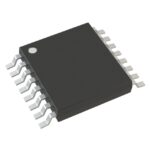 SC16IS741AIPWJ

The activity of extra discounts on wholesale prices is in full swing…
Please fill in your contact information and we will send you the latest wholesale price list.






