 ChipApex | Global Electronic Components Supplier

SEARCH
Search Product
Search Post
— IC芯片 | 连接器 | 传感器 | 被动器件 —
Search productSearch post
— IC芯片 | 连接器 | 传感器 | 被动器件 —
Consult the customer manager about the wholesale price.
consultation hotline:86-132-6715-2157
email:[email protected]
Contact the product manager for consultation. One-stop consultation is available.
Do you want a lower wholesale price? Please send us your inquiry and we will reply immediately.
The SDCW2012-2-261TF is a two-line common mode choke from Shenzhen Sunlord Electronics, designed for surface mount applications. It features an impedance of 260 Ohms at 100 MHz and supports a maximum rated current of 300 mA. The component has a DC resistance (DCR) of 400 mOhm and a rated voltage of 50 V DC. Housed in a compact 2012 package, it is RoHS compliant and intended for high-frequency signal filtering.
Verify the specific suffix TF against official Sunlord documentation to confirm compliance with lead-free and halogen-free requirements. Ensure the ordering part number matches the exact impedance and current ratings required for your circuit design. Cross-reference the datasheet revision history to confirm the latest mechanical dimensions and electrical specifications before finalizing procurement orders.
Select this component when a low-profile, two-line choke is needed for signals requiring 260 Ohms impedance at 100 MHz. The 300 mA current rating must align with the operational load of the protected lines. Consider the 2012 footprint constraints during layout planning. Verify that the 50 V DC rated voltage exceeds the maximum operating voltage of the application to ensure reliability and prevent dielectric breakdown under normal conditions.
This component belongs to the SDCW series of multi-layer chip ceramic inductors manufactured by Shenzhen Sunlord Electronics. The series utilizes advanced ceramic materials to achieve stable performance across varying frequencies. Sunlord specializes in passive components for telecommunications, automotive, and industrial sectors, emphasizing miniaturization and high reliability in their product portfolio.
Consult official Sunlord substitution guides for compatible alternatives. Verify that any substitute maintains identical impedance characteristics at 100 MHz and meets or exceeds the 300 mA current handling capability. Ensure the replacement part fits the same 2012 surface mount footprint and adheres to the same RoHS compliance standards to avoid requalification efforts.
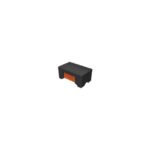 SDCW2012-2-261TF

The activity of extra discounts on wholesale prices is in full swing…
Please fill in your contact information and we will send you the latest wholesale price list.





