 ChipApex | Global Electronic Components Supplier
SEARCH
Search Product
Search Post
— IC芯片 | 连接器 | 传感器 | 被动器件 —
Search productSearch post
— IC芯片 | 连接器 | 传感器 | 被动器件 —
Consult the customer manager about the wholesale price.
consultation hotline:86-132-6715-2157
email:[email protected]
Contact the product manager for consultation. One-stop consultation is available.
Do you want a lower wholesale price? Please send us your inquiry and we will reply immediately.
The SFH6326-X017 is a high-speed, dual-channel optocoupler manufactured by Vishay Semiconductor Opto Division. It features a phototransistor output configuration and operates at data rates up to 1 Mb/s. The device provides an insulation voltage of 5300 Vrms and supports a current transfer ratio exceeding 19%. Key electrical parameters include a maximum forward current of 16 mA, a typical forward voltage of 1.33 V, and a reverse voltage rating of 4.5 V. The output can handle a collector current of 8 mA with a power dissipation of 145 mW. It is housed in an 8-SMD package and functions within a temperature range of -55°C to +100°C.
Verify component authenticity through authorized distributors or direct manufacturer channels. Confirm the specific suffix matches the required package and pinout configuration. Check for RoHS compliance status as indicated in official documentation. Ensure storage conditions adhere to moisture sensitivity levels if applicable. Validate that the supplier provides traceable lot numbers for quality assurance purposes.
Select this component when dual-channel isolation is required alongside moderate speed performance. Consider the 5300 Vrms insulation rating for safety-critical applications. Evaluate the 1 Mb/s data rate against system bandwidth requirements. Assess the phototransistor output compatibility with downstream logic levels. Compare power dissipation limits against thermal management capabilities in the target enclosure.
This part belongs to Vishay's high-speed optocoupler family, designed for reliable digital signal isolation. It serves as a bridge between low-voltage control circuits and higher-voltage industrial environments. The dual-channel design allows for compact board layouts compared to single-channel alternatives. It complements other Vishay isolators offering varying speed and channel configurations.
SFH6326-X001 and SFH6326-X007 are documented variants within the same product line. Verify pin compatibility and electrical parameter equivalence before substitution. Ensure the replacement variant meets the specific insulation and speed requirements of the original design.
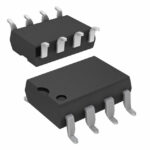 SFH6326-X017
The activity of extra discounts on wholesale prices is in full swing…
Please fill in your contact information and we will send you the latest wholesale price list.






