 ChipApex | Global Electronic Components Supplier
SEARCH
Search Product
Search Post
— IC芯片 | 连接器 | 传感器 | 被动器件 —
Search productSearch post
— IC芯片 | 连接器 | 传感器 | 被动器件 —
Consult the customer manager about the wholesale price.
consultation hotline:86-132-6715-2157
email:[email protected]
Contact the product manager for consultation. One-stop consultation is available.
Do you want a lower wholesale price? Please send us your inquiry and we will reply immediately.
The SFH636-X009 is a single-channel transistor output optocoupler manufactured by Vishay Semiconductor Opto Division. It features an infrared emitting diode optically coupled to an integrated photo detector comprising a photodiode and a high-speed phototransistor. The device provides electrical isolation with an insulation voltage of 4420 Vrms. Key electrical parameters include a minimum current transfer ratio of 19% at 16 mA forward current, a maximum collector-emitter voltage of 30 V, and a maximum collector current of 50 mA. The unit operates within a temperature range of -55°C to +100°C and is housed in a 6-SMD surface-mount package.
Verify the specific suffix X009 against official Vishay documentation to confirm the exact tape-and-reel packaging configuration and quantity per reel. Ensure that the requested component matches the 6-SMD footprint and pinout specifications defined in the datasheet. Cross-reference the manufacturer part number with authorized distributor catalogs to confirm availability status and lead times prior to order placement.
Select this component when application requirements demand both high isolation voltage and improved switching characteristics compared to standard phototransistor-only optocouplers. The integrated photodiode allows for faster response times, making it suitable for applications where signal integrity and speed are critical. Evaluate thermal management needs based on the specified power dissipation and operating temperature range.
This component belongs to the SFH636 series of optocouplers from Vishay Semiconductor Opto Division. The series is characterized by the integration of a photodiode alongside the phototransistor to enhance performance metrics such as propagation delay and bandwidth. The X009 suffix typically denotes a specific surface-mount packaging variant within this product family.
Publicly confirmed substitute part numbers are not available in the provided source material. Verify compatibility with alternative components by comparing pin configurations, isolation voltages, and current transfer ratios against the original design specifications.
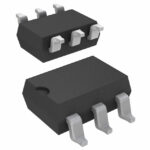 SFH636-X009
The activity of extra discounts on wholesale prices is in full swing…
Please fill in your contact information and we will send you the latest wholesale price list.






