 ChipApex | Global Electronic Components Supplier
SEARCH
Search Product
Search Post
— IC芯片 | 连接器 | 传感器 | 被动器件 —
Search productSearch post
— IC芯片 | 连接器 | 传感器 | 被动器件 —
Consult the customer manager about the wholesale price.
consultation hotline:86-132-6715-2157
email:[email protected]
Contact the product manager for consultation. One-stop consultation is available.
Do you want a lower wholesale price? Please send us your inquiry and we will reply immediately.
The Microchip Technology SHA104-RBVCZ-B is a cryptographic authentication device from the CryptoAuthentication™ family, designed for accessory and disposable applications. It provides 128-bit symmetric security using hardware-based key storage and MAC generation support. The component features an internal NIST SP 800-90A/B/C compliant random number generator (RNG), field-programmable EEPROM with 384 bytes of user memory, and a monotonic counter limited to 10,000 uses. It operates on a voltage supply range of 1.65V to 5.5V with a nominal sleep current of 130nA. The specific RBVCZ-B suffix indicates a 3-Lead Contact package variant utilizing the Single-Wire Interface (SWI).
Verify that the RBVCZ-B suffix corresponds to the 3-Lead Contact package with Single-Wire Interface (SWI) capabilities. Confirm that the application design supports parasitic power mode if VCC is not independently supplied, as this package option allows operation with only two pins connected. Ensure the host system firmware is compatible with the SWI protocol timing specifications.
Select the SHA104-RBVCZ-B when a minimal footprint and reduced interconnect complexity are required for the accessory side of an authentication system. This 3-lead contact package is suitable for applications where PCB space is constrained or direct metal-to-metal contact is preferred over standard surface-mount connectors. Compare against the I2C variants if bidirectional clocking is necessary for the host interface.
The SHA104 is part of the Microchip CryptoAuthentication™ product family, intended as a companion device to microcontrollers or host-side security ICs like the SHA105. It is designed to be microcontroller agnostic and supports various provisioning flows through the Trust Platform, including TrustFLEX and TrustCUSTOM services for secure credential injection.
Publicly confirmed substitute part numbers are not available in the provided documentation. For equivalent functionality, consider other SHA10x series members such as the SHA105 for host-side implementations, though package and interface differences must be evaluated.
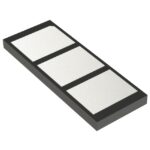 SHA104-RBVCZ-B
The activity of extra discounts on wholesale prices is in full swing…
Please fill in your contact information and we will send you the latest wholesale price list.





