 ChipApex | Global Electronic Components Supplier
SEARCH
Search Product
Search Post
— IC芯片 | 连接器 | 传感器 | 被动器件 —
Search productSearch post
— IC芯片 | 连接器 | 传感器 | 被动器件 —
Consult the customer manager about the wholesale price.
consultation hotline:86-132-6715-2157
email:[email protected]
Contact the product manager for consultation. One-stop consultation is available.
Do you want a lower wholesale price? Please send us your inquiry and we will reply immediately.
The Microchip SHA104-RBVCZ-T is a CryptoAuthentication™ series cryptographic co-processor designed for accessory and disposable applications. It provides 128-bit symmetric security using hardware-based key storage and MAC generation support. The device features a NIST SP 800-90A/B/C certified Random Number Generator (RNG), field-programmable EEPROM with 384 bytes of user memory, and a monotonic counter limited to 10,000 uses. It operates on a voltage range of 1.65V to 5.5V with a nominal sleep current of 130nA. This specific part number utilizes the 3-Lead Contact package (2.5mm x 6.5mm) and supports the Single-Wire Serial Interface (SWI).
Verify that the RBVCZ suffix corresponds to the 3-Lead Contact package variant. Confirm the I/O type matches system requirements, as this model specifies the Single-Wire interface. Ensure provisioning needs align with Trust Platform services if unique credentials are required.
Select this component for applications requiring minimal pin counts on the accessory side. The 3-Lead Contact package allows for parasitic power operation via the SWI interface. Verify compatibility with host firmware supporting challenge-response or shared key protocols.
This device belongs to the Microchip CryptoAuthentication™ family, intended as a companion to microcontrollers. It complements host-side devices like the SHA105 for robust ecosystem security. The SHA104 focuses on cost-effective, low-pin-count solutions for consumables.
SHA104 variants with different packages (e.g., 8-pad UDFN, 8-lead SOIC) offer identical functionality but require PCB layout adjustments. SHA106 is an alternative for true 2-wire implementations with integrated capacitors.
Yes, when configured with the Single-Wire Serial Interface (SWI), the device can be powered through the signal line, reducing the connection to two pins.
The monotonic counter has a maximum value of 10,000, which can be programmed lower during provisioning to limit key usage.
The EEPROM guarantees data retention for up to 40 years at an ambient temperature of +55°C.
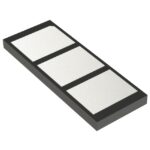 SHA104-RBVCZ-T
The activity of extra discounts on wholesale prices is in full swing…
Please fill in your contact information and we will send you the latest wholesale price list.





