 ChipApex | Global Electronic Components Supplier
SEARCH
Search Product
Search Post
— IC芯片 | 连接器 | 传感器 | 被动器件 —
Search productSearch post
— IC芯片 | 连接器 | 传感器 | 被动器件 —
Consult the customer manager about the wholesale price.
consultation hotline:86-132-6715-2157
email:[email protected]
Contact the product manager for consultation. One-stop consultation is available.
Do you want a lower wholesale price? Please send us your inquiry and we will reply immediately.
The SI2434-C-GTR is a system-side component of the ISOmodem family, designed for embedded modem applications. It supports data rates up to 33.6 kbps using V.34 and V.32bis protocols. The device operates on a digital supply voltage (VD) ranging from 3.0 V to 3.6 V. It features an integrated Direct Access Arrangement (DAA) providing over 6000 V capacitive isolation. The package is a 16-pin SOIC with G-grade availability for industrial temperature ranges (-40 °C to +85 °C). Communication interfaces include UART, SPI, or parallel modes.
Verify the specific ordering suffix against the manufacturer's official documentation to confirm package type and temperature grade. Ensure compatibility with the required Si3018/10 line-side device for complete chipset functionality. Confirm lead times and packaging quantities directly with authorized distributors as these parameters are subject to change without notice.
Select this model when V.90 support is not required, as it is limited to 33.6 kbps speeds. Verify that the 16-pin SOIC footprint meets PCB layout constraints. Ensure the host processor supports the selected interface mode (UART, SPI, or Parallel). Check if the industrial temperature range is necessary for the target environment.
This component belongs to the Skyworks ISOmodem family, which includes the Si2457, Si2415, and Si2404 variants. These devices share similar architectural features but differ in supported maximum data rates and protocol capabilities. The SI2434 specifically targets applications requiring reliable connectivity up to 33.6 kbps without the complexity of higher-speed V.90 implementations.
Si2457-D-FT: Supports higher speeds up to 56 kbps with V.90.
No, the SI2434 supports data rates up to 33.6 kbps using V.34 and V.32bis protocols. V.90 support is exclusive to the Si2457 variant.
The device supports flexible clock options including a low-cost 32.768 kHz oscillator, a 4.915 MHz oscillator, or a 27 MHz clock input.
No, the device contains on-chip RAM and ROM, eliminating the need for external memory components.
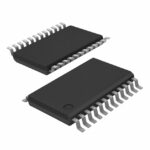 SI2434-C-GTR
The activity of extra discounts on wholesale prices is in full swing…
Please fill in your contact information and we will send you the latest wholesale price list.





