 ChipApex | Global Electronic Components Supplier
SEARCH
Search Product
Search Post
— IC芯片 | 连接器 | 传感器 | 被动器件 —
Search productSearch post
— IC芯片 | 连接器 | 传感器 | 被动器件 —
Consult the customer manager about the wholesale price.
consultation hotline:86-132-6715-2157
email:[email protected]
Contact the product manager for consultation. One-stop consultation is available.
Do you want a lower wholesale price? Please send us your inquiry and we will reply immediately.
The Si3016-F-FS is a 3.3 V enhanced global direct access arrangement (DAA) line-side device manufactured by Silicon Laboratories Inc. It integrates an analog front end, isolation barrier, and hybrid into a single 16-pin SOIC package to replace discrete components. The device supports programmable AC/DC termination for global compliance, including FCC and CTR21 standards. Key electrical parameters include a dynamic range of up to 84 dB, transmit/receive levels of -1 dBm or +3.2 dBm, and operation with 3.3 V or 5 V supplies. It interfaces directly with system-side processors via a serial link.
Verify the specific ordering suffix against the manufacturer's current datasheet to ensure correct packaging and temperature grade. Confirm that the host processor meets the required specifications for the integrated system-side DAA module. Check for RoHS compliance status if environmental regulations apply to the final assembly.
Select this component when designing telephone line interfaces requiring global regulatory compliance with minimal discrete component count. Ensure the system-side module supports the necessary serial communication protocol. Verify that the application environment falls within the specified operating temperature ranges for the chosen grade.
The Si3016 is part of Silicon Laboratories' integrated DAA family, designed to simplify telephone line interface designs. It works in conjunction with a system-side interface device to provide complete line-side functionality. This integration significantly reduces board space and cost compared to traditional discrete DAA solutions.
Public confirmed substitute part numbers are not available in the provided documentation. Designers should consult the manufacturer's official replacement guide or contact technical support for validated alternatives.
It uses proprietary capacitive isolation technology combined with low-cost, high-voltage capacitors and signal processing techniques to eliminate signal degradation and common-mode interference.
The device supports both 3.3 V and 5 V power supplies. When on-hook, it draws power across the isolation link from the system-side module; when off-hook, it draws power from the 2-wire line.
Yes, it can detect parallel handsets going off-hook by monitoring loop current drops via the LVCS bits or detecting significant drops in line voltage when on-hook.
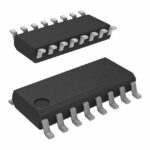 SI3016-F-FS
The activity of extra discounts on wholesale prices is in full swing…
Please fill in your contact information and we will send you the latest wholesale price list.





